Roughly 7 out of every 10 shoppers who add something to their cart leave without buying it. That is not a small leak. For most online stores, it is the single biggest source of lost revenue, and it happens quietly, every single day, while the owner is busy packing orders or answering the same shipping question for the hundredth time. This is exactly the kind of problem AI automation for ecommerce was built to solve. It plugs the leaks, handles the repetitive work, and keeps your store selling around the clock without you watching it.
This guide walks through how to automate your online store step by step. You will see where AI fits across the shopping journey, the specific automations worth setting up first, and how to start without a developer or a big budget. Whether you run a Shopify store, a WooCommerce shop, or sell on your own site, the principles are the same.
What Is AI Automation for Ecommerce?
AI automation for ecommerce means using artificial intelligence to run the repetitive, time-sensitive parts of your online store on their own. Instead of you manually chasing abandoned carts, answering order questions, or updating stock levels, intelligent systems handle those jobs in real time and only involve you when something genuinely needs a human.
The difference from basic store apps is that AI adapts. A standard plugin sends the same reminder email to everyone. An AI system reads the situation, who the shopper is, what is in their cart, whether stock is low, and responds in a way that actually fits the moment. If you want the broader picture of how this works beyond stores, our complete guide on what AI automation is and how it works covers the fundamentals.
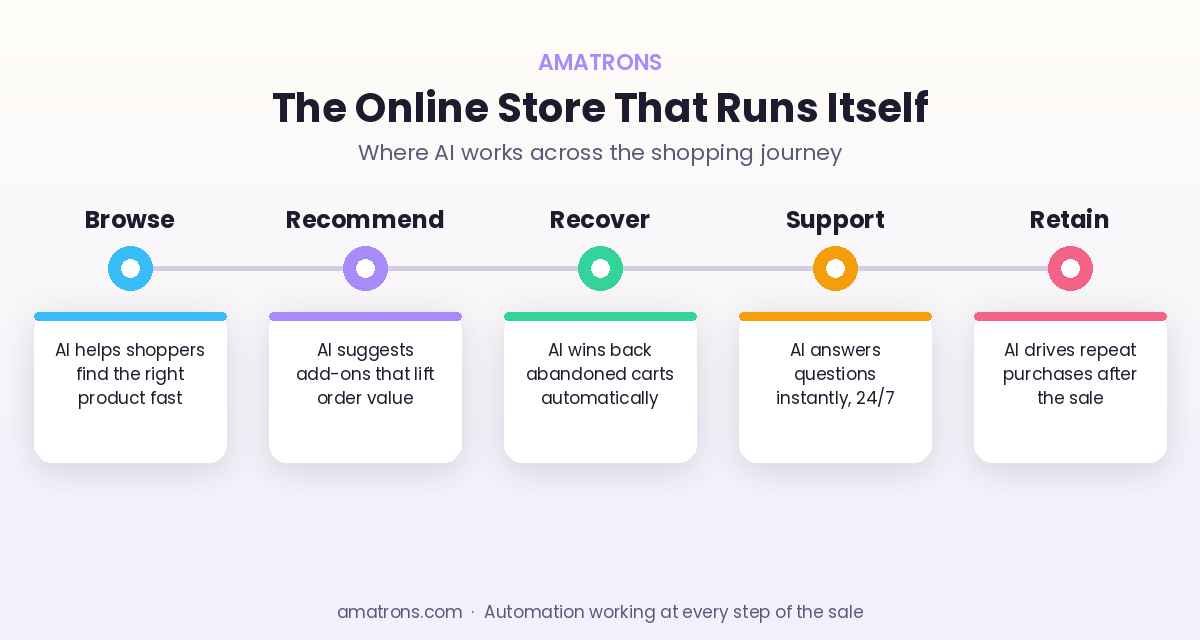
Notice that AI does not just sit in one place. It works across the whole journey, helping shoppers find products, recovering carts they abandon, answering their questions, and bringing them back after the sale. That is what turns a store into one that keeps selling while you sleep.
Why Ecommerce Automation Is Worth It
The numbers here are hard to argue with, because ecommerce is a game of small percentages applied to large volumes. Shaving a few points off cart abandonment or lifting average order value a little adds up fast.
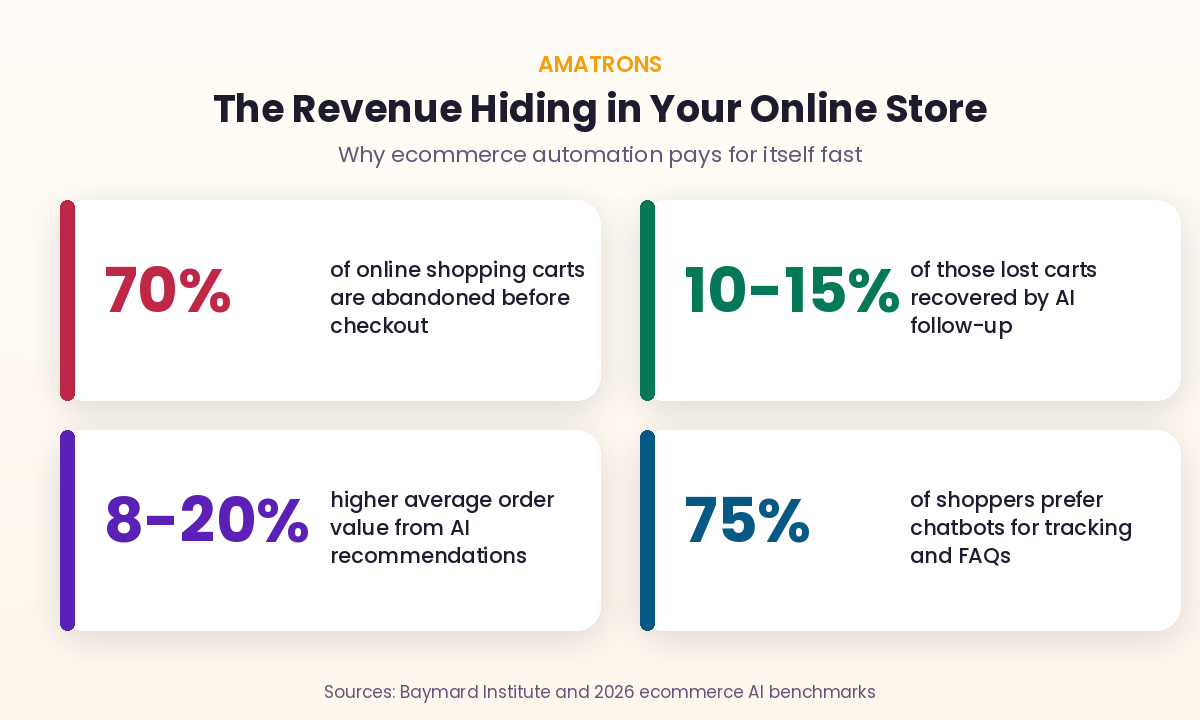
The Baymard Institute puts the average cart abandonment rate at around 70%, and AI follow-up typically recovers 10 to 15% of those lost carts, revenue that would otherwise vanish. On top of that, AI product recommendations lift average order value by 8 to 20%, and around 75% of shoppers now actually prefer a chatbot for quick tasks like order tracking and FAQs. Stack those gains together and the return shows up within the first month or two, which is why this is one of the fastest-paying automations any small business can make. The wider case for it is laid out in our breakdown of the real ROI of AI automation.
The 6 Ecommerce Automations to Set Up First
You do not automate everything at once. You start with the handful that recover the most revenue and save the most time. Here are the six that deliver the fastest return, roughly in the order I would set them up.
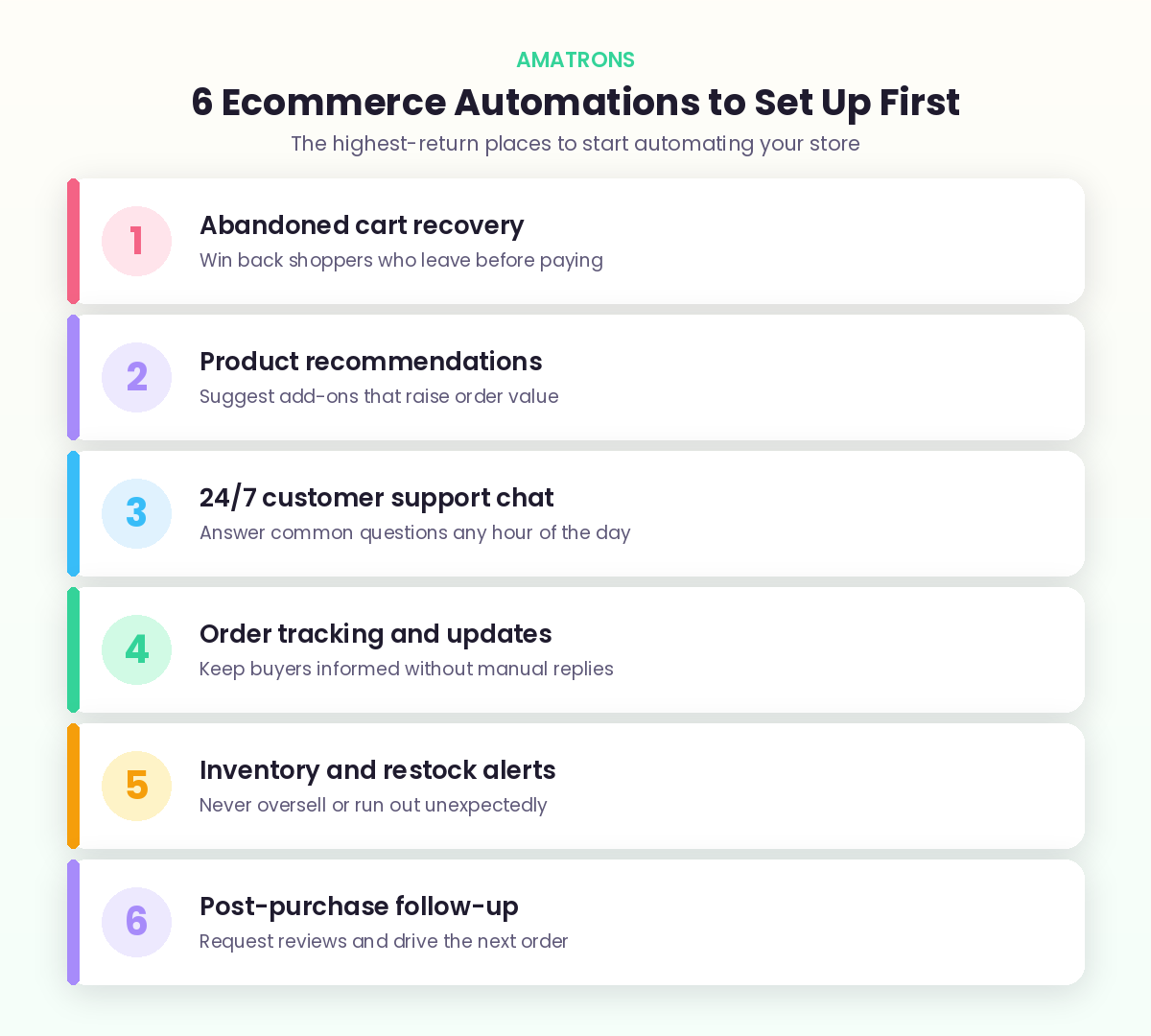
1. Abandoned Cart Recovery
This is where the money is, so start here. When a shopper leaves with items in their cart, AI follows up automatically across email, chat, or SMS with a personalised nudge, sometimes answering the exact objection that stopped them. Because it recovers 10 to 15% of otherwise lost sales, this one automation often pays for your entire setup on its own.
2. Product Recommendations and Upsells
AI studies what a shopper is viewing and buying, then suggests relevant add-ons at the right moment, the digital version of a great shop assistant saying “this goes well with that.” Done naturally inside the journey, it lifts average order value without feeling pushy, which is why it consistently delivers 8 to 20% bigger baskets.
3. 24/7 Customer Support Chat
Most store questions are the same handful repeated endlessly: where is my order, what is your return policy, does this come in another size. An AI support chat answers these instantly at any hour and only passes the genuinely tricky ones to you. For a deeper build, see how an AI support bot handles this end to end.
4. Order Tracking and Shipping Updates
“Where is my order” is the most common message any store gets. Automating tracking updates and proactive shipping notifications removes that entire category of work, keeps customers calm, and stops your inbox filling up with questions you would otherwise answer one by one.
5. Inventory and Restock Alerts
Running out of a bestseller or overselling stock you do not have are both expensive mistakes. AI can monitor stock levels, forecast demand, and alert you or reorder before you run dry. Inventory automation alone has been shown to cut excess holdings by 20 to 30%, freeing up cash tied in the wrong products.
6. Post-Purchase Follow-Up
The sale is not the end, it is the start of the next one. AI can send the right follow-up at the right time to request a review, recommend a reorder, or invite the customer back with a relevant offer. This is how a one-time buyer quietly becomes a repeat customer without you lifting a finger.
How to Automate Your Online Store in 4 Steps
Knowing what to automate is half the job. Here is the practical sequence to actually get it running, even if you have never built an automation before.
- Find your biggest leak. Look at your store data. Is it abandoned carts, slow support replies, or low repeat purchases? Start with the one costing you the most. For most stores, that is cart abandonment.
- Pick a tool that connects to your store. Choose something with a native integration for your platform, whether that is Shopify, WooCommerce, or another. The connection is what makes the automation aware of real orders and stock.
- Set up one automation and test it. Build the single highest-value workflow first, usually cart recovery, and run real orders through it before trusting it fully. Keep it simple: one trigger, one smart action.
- Measure, then add the next one. Track recovered carts, order value, and support replies handled. Once the first automation is clearly paying off, move to the next on the list and let each win fund the one after.
The Tools That Power Ecommerce Automation
You do not need a custom-built system to start. A few categories of tool cover most of what a small store needs, and many have free or low-cost tiers.
For the storefront itself, platforms like Shopify now bundle AI features directly into the dashboard. For email and SMS automation, including abandoned cart flows, tools such as Klaviyo are built specifically for ecommerce. For support, an AI chat tool that connects to your order system handles the questions, and for everything else, a workflow builder ties the pieces together. We compare the main options in our guide to the best AI automation tools for small businesses, and the underlying connections are handled by workflow automation.
Mistakes to Avoid When Automating Your Store
Automation done badly can cost you customers, so steer clear of these common traps.
- Hiding the human option. An AI chat that traps frustrated customers with no way to reach a person will lose sales. Always offer an easy handoff for the tricky cases.
- Over-emailing recovered carts. One or two well-timed, helpful nudges work. Five aggressive emails annoy people and get you marked as spam.
- Automating on messy data. If your product information or stock counts are wrong, automation just spreads those errors faster. Clean the data first.
- Setting it and forgetting it. The first few weeks need tuning. Check what the AI is saying and recommending, and refine it before you fully step back.
What This Looks Like in a Real Store
It helps to see the pieces working together rather than as a list. Picture a small store selling skincare, run by one founder who also packs every order.
Before automation, her day looked like this. Mornings vanished into answering the same three questions about shipping and ingredients. Carts were abandoned overnight and never followed up because she was asleep. Repeat customers only came back if they happened to remember the brand. Bestsellers sold out without warning, costing sales and disappointing buyers.
After setting up automation over a couple of weeks, the picture changed. An AI chat now answers the routine questions instantly, day and night, and only flags the unusual ones for her. Every abandoned cart gets a friendly, timely follow-up that wins back a meaningful share of them. After each delivery, a follow-up message asks for a review and suggests a sensible reorder date. Stock alerts warn her before a bestseller runs dry. She did not hire anyone. She did not learn to code. She plugged the leaks one at a time, and the store now does the repetitive work that used to eat her mornings. That is the real promise here: not robots running everything, but the boring, revenue-leaking tasks finally handled so the owner can focus on product and growth.
Where Ecommerce Automation Is Heading Next
It is worth knowing where this is going, because the shift is already underway and it rewards the stores that prepare early. Shopping itself is becoming conversational. A growing share of buyers, roughly one in three, now use AI tools like chatbots and visual search during their purchase journey rather than browsing pages alone.
There is also a brand new traffic source forming. Shoppers increasingly research and discover products directly inside AI assistants, and that traffic converts notably higher than average because the intent is so strong. Generative AI and AI agents drove an estimated $262 billion in global retail revenue during the 2025 holiday season, around a fifth of total sales. Stores that structure their product information clearly, the way these AI systems can read and recommend it, are the ones being surfaced to those buyers.
The practical takeaway is simple. The automations in this guide are not just about saving time today. They are how you position your store for a world where customers expect instant answers, personalised help, and to be met wherever they are shopping, including inside an AI assistant. Getting the basics running now is what puts you ahead of that curve instead of scrambling to catch up to it.
Does Your Store Need This Yet?
Honesty matters here, because not every store needs all of this on day one. If you are getting only a handful of orders a week, spending hours wiring up six automations is the wrong focus. Your energy is better spent getting traffic and proving the product sells at all. Automation multiplies an existing flow, it does not create one from nothing.
That said, there is one exception worth acting on early no matter your size: abandoned cart recovery. Even a small store loses real money to abandoned carts, and the setup is quick and cheap enough to be worth it almost immediately. So the simple rule is this. If you are pre-traffic, focus on traffic first and switch on cart recovery as your one automation. If you are getting steady daily orders and starting to feel buried in support messages, repetitive admin, or missed follow-ups, that is the signal you have outgrown doing it by hand. That is the moment automation stops being a nice idea and starts being the thing holding your time and revenue back. Most growing stores hit that point sooner than they expect, and the ones that act on it pull away from the ones that keep grinding manually.
Frequently Asked Questions
What is AI automation for ecommerce?
How does AI reduce cart abandonment?
Do I need a developer to automate my online store?
How much does ecommerce automation cost?
Which ecommerce automation should I set up first?
The Bottom Line
Your online store is probably leaking revenue right now through abandoned carts, slow replies, and one-time buyers who never come back. AI automation for ecommerce closes those gaps and runs the repetitive work for you, so the store keeps selling at 2am as well as 2pm. You do not need to automate everything or hire a developer to begin. Find your biggest leak, set up one automation to plug it, prove it pays, and build from there. Start with abandoned carts, because that is where the fastest money is hiding, and let the first win fund the rest.