You’re losing time you can’t afford to lose. Every hour spent manually chasing invoices, replying to the same customer questions, or copy-pasting data between spreadsheets is an hour not spent growing your business. AI automation changes that and in 2026, it’s no longer just for tech giants with million-dollar budgets.
This guide explains exactly what AI automation is, how it works, where it delivers the biggest ROI for small and medium businesses, and how you can start even if you have no technical background whatsoever.
- ✓ What AI automation actually means (plain English definition)
- ✓ How it differs from basic automation tools like Zapier or spreadsheet macros
- ✓ The 6 business areas where it delivers the fastest ROI
- ✓ Real examples from businesses using it right now
- ✓ How to start in the next 14 days — no tech team required
What Is AI Automation? (The Plain-English Definition)
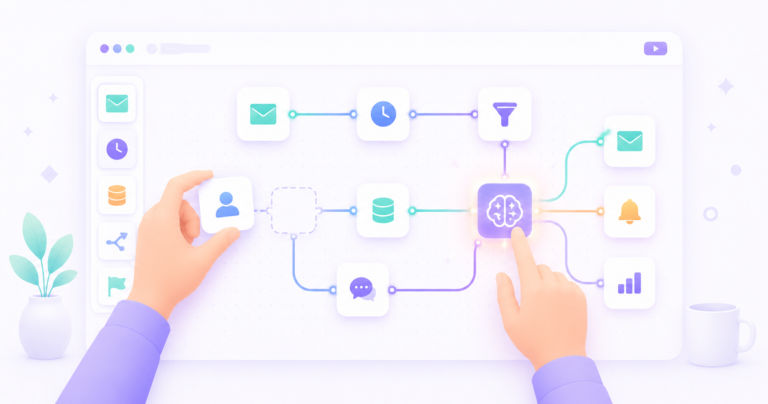
AI automation is the use of artificial intelligence software to handle tasks that previously required human attention things like reading emails, making decisions based on data, writing responses, categorising information, and triggering actions in other tools.
The key word is intelligent. Traditional automation follows rigid rules: “if invoice received, move to folder.” AI automation can read, understand context, and adapt: “if invoice received, check it against our purchase orders, flag discrepancies, and send a Slack alert to the finance team with a summary.”
A simple way to think about it: Traditional automation is a conveyor belt — predictable, fast, but only moves in one direction. AI automation is more like a junior employee — it reads, makes judgements, and handles the unexpected. Want the full breakdown of how the two stack up? Read our deep dive on AI automation vs traditional automation.
Why AI Automation Matters for Small Businesses in 2026
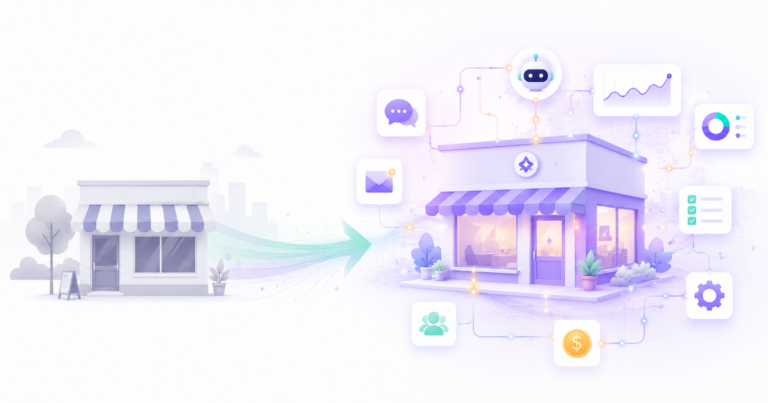
For years, intelligent automation was the domain of enterprises with dedicated engineering teams. That changed rapidly between 2023 and 2026. Today, tools like Make, n8n, and custom AI agents make it possible for a 5-person team to automate workflows that would have required a developer two years ago. For the bigger picture, see exactly how AI is changing the way small businesses operate in 2026.
The businesses winning right now are not the ones with the biggest budgets. They’re the ones that moved fastest to automate the work that used to eat their team’s week. Curious what those returns actually look like in hard numbers? See our breakdown of the real ROI of AI automation, with average returns and payback periods from real businesses.
6 Business Areas Where AI Automation Delivers Fast ROI
You don’t automate everything at once. For a wider list of opportunities, see our roundup of 10 business processes to automate with AI. The highest-return starting points for most businesses are:
1. Lead Generation and Qualification
AI can monitor LinkedIn, web forms, and email inboxes to identify potential leads, score them based on your ideal customer profile, and automatically add them to your CRM with a personalised outreach message drafted and ready to send. What used to take a sales rep 3 hours a day now runs continuously in the background.
2. Customer Support and Onboarding
An AI support agent handles 80–90% of repetitive customer questions — order status, how-to guides, account queries — across WhatsApp, email, and web chat simultaneously. It escalates complex cases to a human with full context already summarised. Response times drop from hours to seconds. The same approach works for welcoming new clients, see our step by step guide on how to automate customer onboarding in 5 steps.
3. Invoice and Finance Admin
AI reads incoming invoices, matches them against purchase orders, flags discrepancies, and posts approved entries to your accounting software. 36% of businesses using automation report at least a 25% reduction in processing costs within the first year.
4. Content and Marketing
AI drafts first versions of blog posts, social media captions, email newsletters, and ad copy based on a brief. Your team edits and approves rather than writing from scratch. Output goes from 2 pieces a week to 10+ — same headcount.
5. Reporting and Data Entry
AI pulls data from your CRM, ads platform, and website analytics, compiles it into a weekly report, and sends it to the right people every Monday morning. No spreadsheet. No manual exports. No one “forgetting” to send it.
6. HR and Recruitment
AI screens CVs against your job criteria, schedules interviews automatically, sends reminders, and follows up with rejected candidates. Companies save 30% on cost-per-hire by automating screening — not by cutting corners, but by cutting admin.
A Real Example: What AI Automation Looks Like in Practice
Here’s a workflow Amatrons built for a 12-person consulting firm in the UAE:
- 1Prospect fills enquiry form on website
- 2AI reads the form, scores the lead against ICP criteria
- 3CRM entry created automatically with lead score and source
- 4Personalised follow-up email sent within 90 seconds
- 5If no reply in 48 hours — AI sends follow-up #2 with a different angle
- 6Qualified lead booked into calendar via AI scheduling bot
- 7Onboarding documents sent automatically on booking confirmation
- 8Weekly pipeline report compiled and sent to founder every Monday
Before this automation, two team members spent roughly 14 hours per week on this process. After: under 90 minutes of human review. The system runs 24 hours a day, across time zones, without anyone manually managing it. For a full breakdown of how a business reclaims an entire week this way, read our AI automation case study.
What AI Automation Is NOT
There’s a lot of noise around AI right now, so it’s worth being precise about what we’re talking about — and what we’re not.
How to Start with AI Automation: Your First 14 Days
Most businesses overthink the starting point. Here’s the fastest path from zero to your first working automation:
AI Automation Tools Worth Knowing in 2026
You don’t need to choose one tool forever. Most businesses use a combination:
For a deeper look at each option, including current 2026 pricing, free tiers, and a recommended starter stack by budget, read our full guide to the best AI automation tools for small businesses.
5 Common AI Automation Mistakes (And How to Avoid Them)
Frequently Asked Questions
The Bottom Line
AI automation is not a futuristic concept — it’s the operating system of a competitive business in 2026. The companies gaining ground right now are the ones that stopped treating it as a tech project and started treating it as a business strategy.
You don’t need a big team, a big budget, or a technical background to start. You need one clear process, one well-built automation, and the discipline to measure the result. Everything grows from there.
Start small. Start now. Start with the task that’s eating the most time.