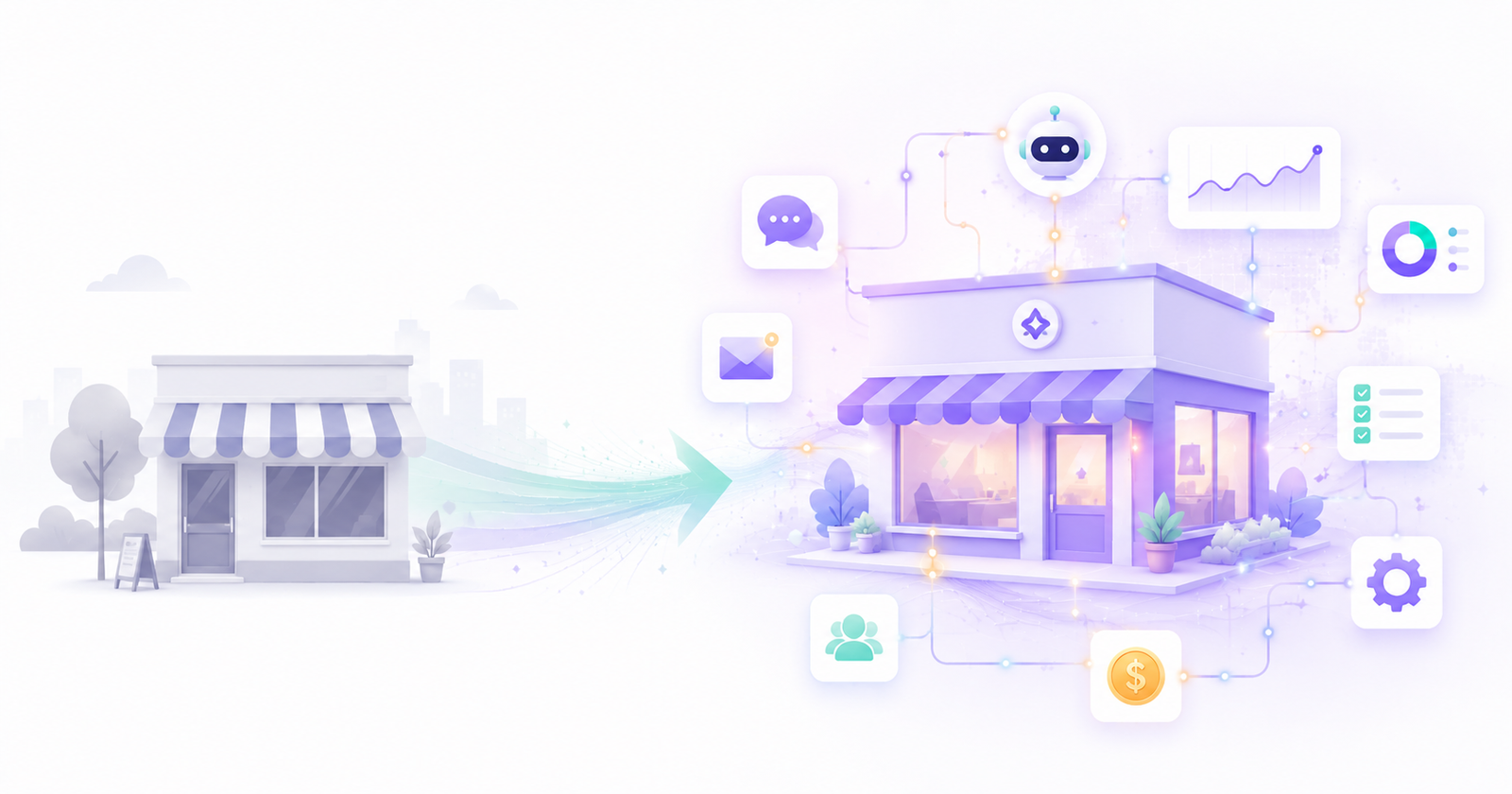
A decade ago, the tools that ran a serious business were locked behind enterprise budgets. Marketing teams, data analysts, round-the-clock support desks, all of it took headcount and money most small businesses simply did not have. That wall has come down. Understanding how AI is changing small business is no longer a topic for tech conferences. It is the difference between the shops on your street that are quietly pulling ahead and the ones wondering why they suddenly feel slow.
This is not a hype piece. It is a clear look at what has actually shifted in how small businesses run day to day, backed by current data, and what those shifts mean for you if you run a lean operation in 2026. The headline is simple. AI has handed small businesses the kind of leverage that used to belong only to big ones.
AI Has Crossed From Hype to Habit
The most important change is that this stopped being optional. For years, AI was something small businesses meant to look into someday. That someday arrived. Regular AI use among US businesses jumped from 48% in mid-2024 to 77% by January 2026, according to the Intuit QuickBooks 2026 AI Impact Report.
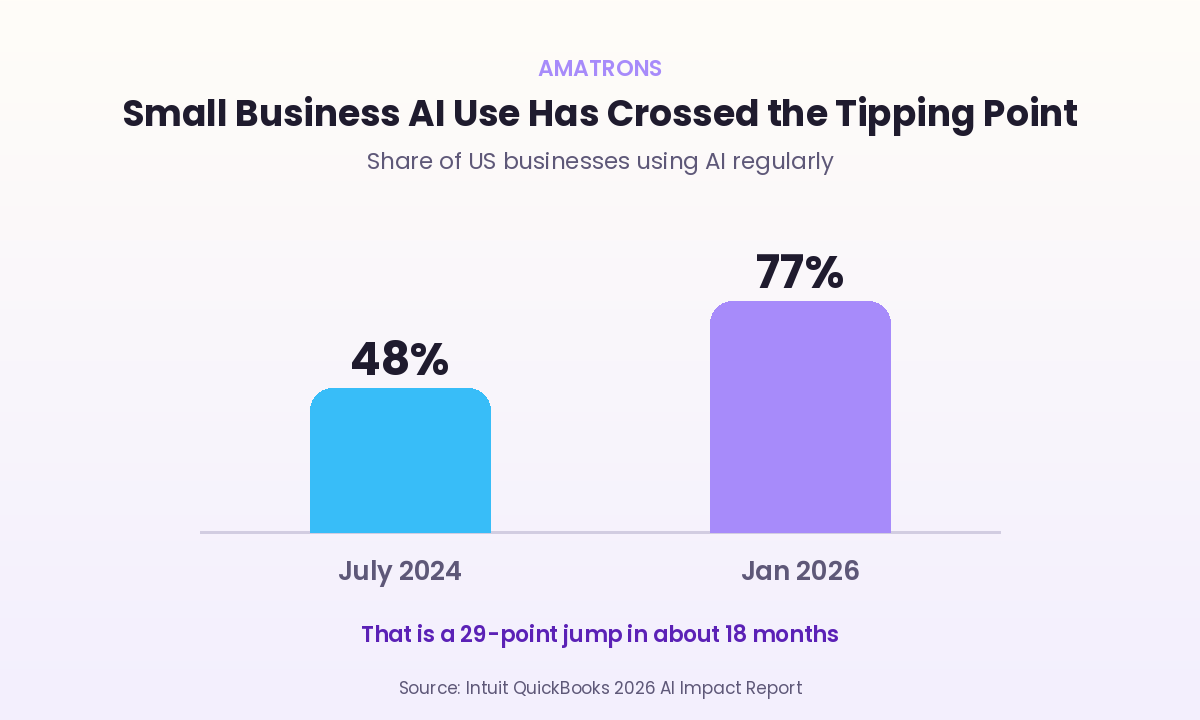
A jump like that in under two years is not a trend. It is a shift in the baseline. When most of your competitors are using a tool, it stops being an edge and starts being the price of staying in the game. The businesses still on the sidelines are no longer early. They are late, and the gap is widening every quarter.
Why the Shift Happened So Fast
Technology usually creeps into small business slowly. This did not. Three forces hit at once and collapsed the barrier that had kept advanced tools out of reach for decades.
First, generative AI made the technology speak human. You no longer need to code or learn complex software. You type what you want in plain English and it responds. That single change took AI from a specialist tool to something any owner could use on day one. Second, no-code platforms removed the developer. Tools that connect your apps and build automations now work with drag-and-drop and templates, so a non-technical owner can assemble a working system over a weekend. Third, the cost collapsed. Capable AI tools that would have cost a fortune to build now start free or run for the price of a few coffees a month.
Put those together and you get the fastest adoption curve small business has ever seen. The wall came down not because owners suddenly got more technical, but because the tools finally met them where they are. That is also why waiting no longer makes sense. The reasons people used to give for holding off, too complex, too expensive, needs a developer, have all quietly disappeared. What is left is simply whether you decide to start.
5 Ways AI Is Changing How Small Businesses Operate
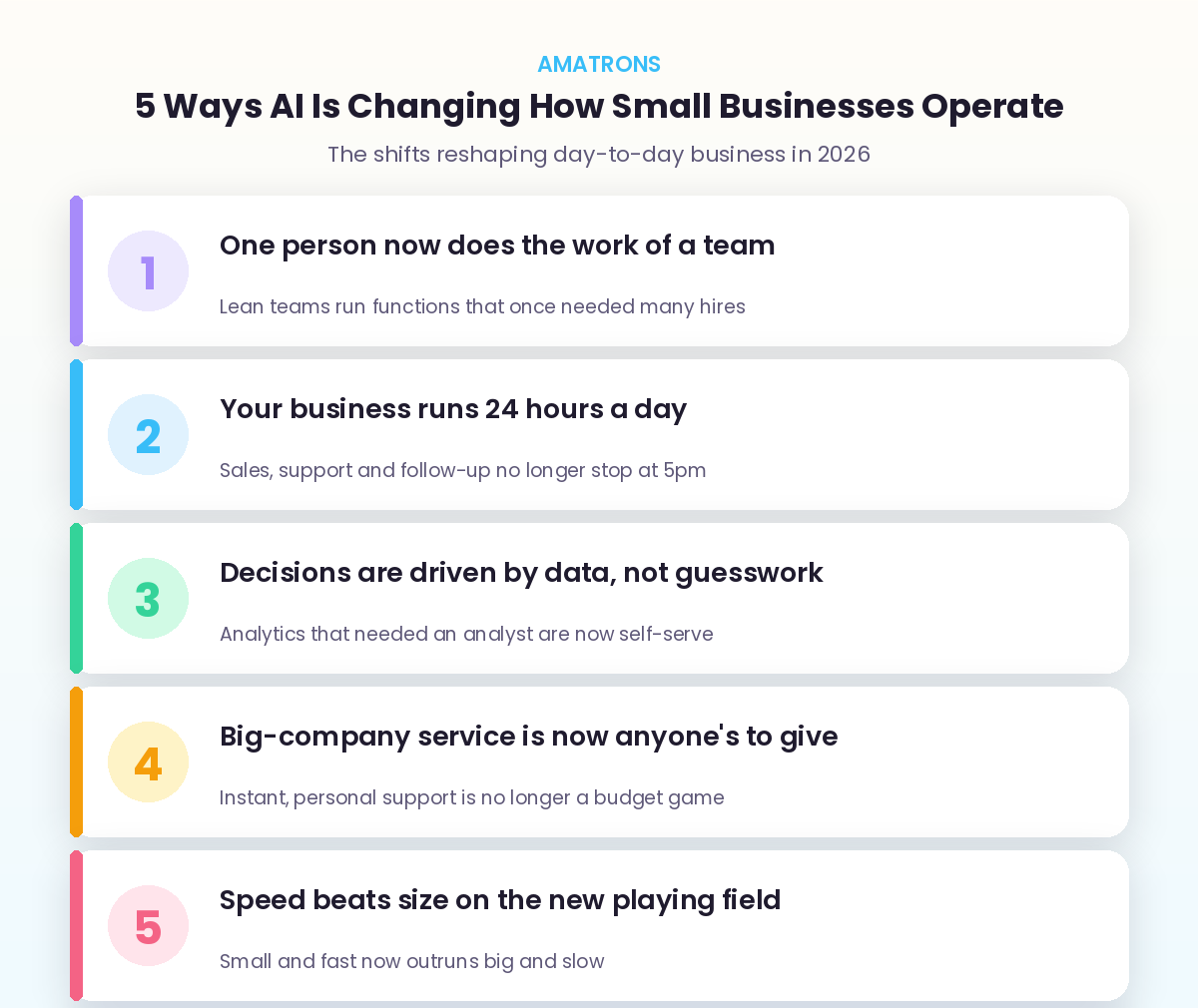
The statistics are interesting, but what matters is how the actual work has changed. Here are the five shifts reshaping day-to-day operations for small businesses right now.
1. One Person Now Does the Work of a Team
This is the biggest change of all. A solo founder can now run marketing, sales follow up, customer support, and reporting at a level that used to need four hires. As one finding in the Intuit report put it, AI lets a small team operate with the maturity and delivery capability of a much larger organisation. You are no longer limited by how many people you can afford. You are limited by how well you set up your systems.
2. Your Business Runs 24 Hours a Day
A small business used to go quiet the moment its owner logged off. Not anymore. An AI setup answers customer questions at midnight, follows up with a lead the second they enquire, and processes orders while you sleep. The clock stopped being a limit. Your business now keeps working across time zones and weekends without anyone sitting at a desk, which is something only large operations could manage a few years ago.
3. Decisions Are Driven by Data, Not Guesswork
Knowing which products sell, which marketing actually works, and where money leaks used to require an analyst most small businesses could not justify. AI now pulls that picture together automatically and explains it in plain language. Owners make sharper calls because they can finally see what is happening instead of guessing. The instinct still matters, but now it is backed by numbers anyone can read.
4. Big-Company Customer Service Is Now Anyone’s to Give
Instant replies, personalised follow ups, and support that never sleeps were once a budget game only big brands could win. AI flipped that. A two-person business can now offer the kind of fast, attentive service that builds loyalty, and over half of small businesses report a noticeable improvement in customer experience after adopting AI tools. The smallest player in a market can now feel like the most responsive one.
5. Speed Beats Size on the New Playing Field
Being small used to mean being out-resourced. Now it often means being faster. While large companies wrestle with committees and legacy systems, a nimble business can adopt a new AI tool over a weekend and act on it Monday morning. Speed of execution has become a genuine competitive weapon, and it is one that favours the small and focused over the big and slow.
The Results Are Real, Not Just Hype
It would be easy to dismiss all this as noise if the results were not showing up on the bottom line. They are. Businesses using AI are far more likely to report gains than setbacks.
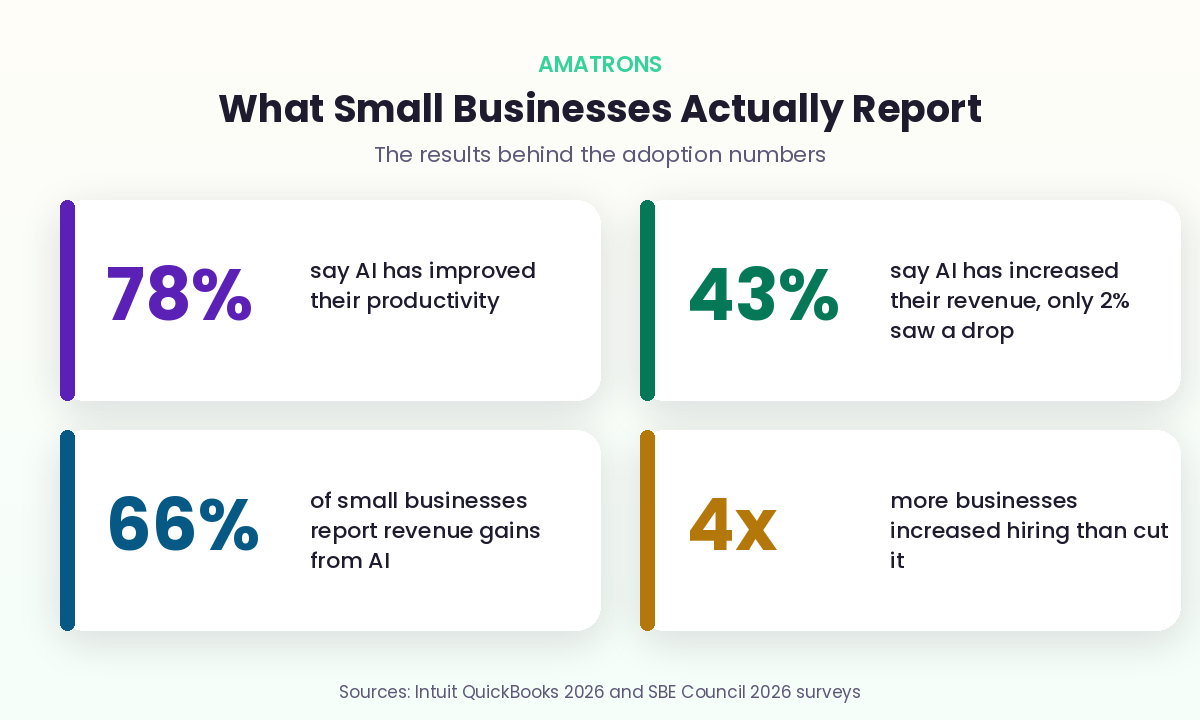
Notice the hiring figure, because it cuts against the fear. Four times as many businesses increased hiring as cut it after adopting AI. The pattern on the ground is not AI replacing people. It is AI removing the busywork so the people you do have can focus on growth, which often means hiring more, not fewer. If you want to see exactly what these returns look like in pounds and dollars, our breakdown of the real ROI of AI automation lays out the numbers and payback periods.
The Widening Gap Between Operators and Explorers
Here is the part that should light a fire under you. The data shows two groups pulling apart. There are the operators, who have built working AI into how they run, and the explorers, who are still reading about it and meaning to start. Surveys consistently find that the businesses seeing real benefits are the ones that moved past experimenting and actually implemented.
That gap compounds. Every month an operator runs AI workflows, they get faster, cheaper, and more responsive, while the explorer stays exactly where they were. This is not a wave you can catch late and still ride. The advantage goes to whoever builds first and keeps refining. The window to get ahead of your local competitors, before they all adopt too, is open now and narrowing.
Picture two competing businesses on the same street. One replies to every enquiry within seconds, day or night, follows up automatically, and knows exactly which offers are working from a weekly report that builds itself. The other replies when the owner gets a free moment, forgets half the follow ups, and guesses at what is selling. A year ago these two looked the same to a customer. Today the first feels like a sharp, modern operation and the second feels slow, even if the second owner works longer hours. Nothing about their products changed. Only their systems did. That is the gap, and it is being decided right now by who set up AI and who kept meaning to.
Which Small Businesses Are Changing Fastest
The shift is not evenly spread. Some types of business have leaned in harder because the fit is so natural, and they offer a useful preview of where everyone is heading.
Service businesses like coaches, consultants, and agencies are moving quickest, because so much of their work is communication, follow up, and admin that AI handles well. E-commerce stores are close behind, using AI for product descriptions, customer queries, and inventory decisions. Local service providers such as clinics, salons, and trades are adopting AI scheduling and reminders to cut no-shows and free up front-desk time. Even traditionally offline businesses are using AI to handle their marketing and customer messaging.
The common thread is repetition. Any business with tasks that happen the same way over and over has the most to gain, and that describes nearly every small business. Broader research backs this up. McKinsey’s State of AI research shows adoption climbing across functions, with the strongest gains where work is high-volume and rules-based. If you are wondering whether your business fits, the honest answer is that almost all of them do. The only question is which task you start with, and our roundup of the business processes to automate with AI is a good place to find yours.
What AI Cannot Change
For all the shifts, it is worth being honest about the limits, because pretending AI does everything is how businesses waste money on it. AI is an amplifier, not a replacement for the things that actually make a business worth choosing.
It cannot set your strategy. It does not know what your business should stand for, which customers you want, or what bet to make next. That judgment is still yours. It cannot build genuine relationships, the trust and rapport that turn a one-time buyer into a loyal client who refers others. And it cannot care. The warmth a real human brings to a hard conversation, an apology, or a moment that matters is something no tool replicates.
This is the reassuring part of the whole story. AI changes how the routine work gets done, which frees you to spend more of your time on exactly the things it cannot do. The businesses winning with AI are not the ones that handed everything over to machines. They are the ones that let AI take the busywork so the humans could be more human where it counts. Used well, it does not make your business less personal. It gives you the time to make it more so.
What This Means for Your Business
So what do you actually do with all this? You do not need to overhaul everything overnight. You need to start, on purpose, with one thing.
- Pick the one task eating your week. The most repetitive, time-draining job you do is your starting point. That is where AI pays back fastest.
- Understand the basics before you buy. Knowing what AI automation actually is keeps you from wasting money on the wrong tool.
- Choose one tool and prove it. Use a free tier, get a single workflow running, and measure the time it gives back.
- Then expand, funded by the first win. Each working system pays for the next, so you grow your setup without gambling.
If you are not sure where to begin, start with our complete guide on what AI automation is and how it works, then look at the best AI automation tools for small businesses to pick your first one. And if you would rather have the whole system built for you so you can skip the learning curve, that is exactly what our AI automation service is for.
Frequently Asked Questions
How is AI changing small businesses in 2026?
What percentage of small businesses use AI now?
Is AI replacing jobs in small businesses?
Do small businesses actually see results from AI?
How can a small business start using AI without a big budget?
The Bottom Line
The story of how AI is changing small business comes down to one word: leverage. The tools that once separated the big players from everyone else are now available to a business of one. That levels the field in a way that has never happened before, but only for the businesses that actually pick them up. The data is clear that the operators are pulling away from the explorers, and the gap gets harder to close every month. You do not need to do everything. You need to start with one task, prove it works, and build from there. The businesses that do will spend the next decade operating like companies ten times their size.