You bought automation to stop doing busywork, then watched it fall apart the first time something unexpected showed up. A customer asked the same question in different words. An invoice arrived in a new format. A lead replied in a way your tool did not expect. And just like that, a human had to jump back in. That breaking point is the whole story behind AI automation vs traditional automation. Both promise to take work off your plate. Only one of them can actually think.
This guide explains the real difference between AI and traditional automation in plain language, shows which type fits which job, and gives you a simple test to decide where to put your money first. By the end you will know exactly what to automate with rules, what to automate with intelligence, and why the businesses pulling ahead in 2026 quietly use both.
What Is Traditional Automation?
Traditional automation is software that completes tasks by following a fixed set of instructions you define in advance. It runs on simple logic. When this happens, do that. Nothing more, nothing less.
You already use it more than you realise. An email autoresponder that fires when someone fills a form is traditional automation. A spreadsheet formula that totals a column is traditional automation. So is a tool like Zapier moving a new lead from a form into your CRM, or a billing system that sends the same reminder on day 7 and day 14.
This category also covers robotic process automation, usually shortened to RPA, which copies the clicks and keystrokes a person would make to shuffle data between systems. Banks and large back offices have leaned on it for years. Its strengths are real: it is cheap to run, predictable to the decimal, and easy to audit because every step is a rule you can read. Its weakness is just as clear. The moment reality steps outside the rules, it stops.
What Is AI Automation?
AI automation is software that completes tasks by learning from data and reasoning about context, instead of following rules written by hand. Rather than being told every step, it works out the right action based on patterns and the situation in front of it.
This is the layer that reads a customer message written in casual language and knows whether it is a refund request, a complaint, or a sales question. It is the agent that drafts a reply in your brand voice, pulls the right order details, and decides whether to resolve the issue or hand it to a human. People also call this intelligent automation, because it blends machine learning, language understanding, and decision making into one workflow. The practical payoff is that AI automation gets sharper the more it runs, while a rule-based tool stays frozen at whatever you set on day one.
AI Automation vs Traditional Automation: The Key Differences
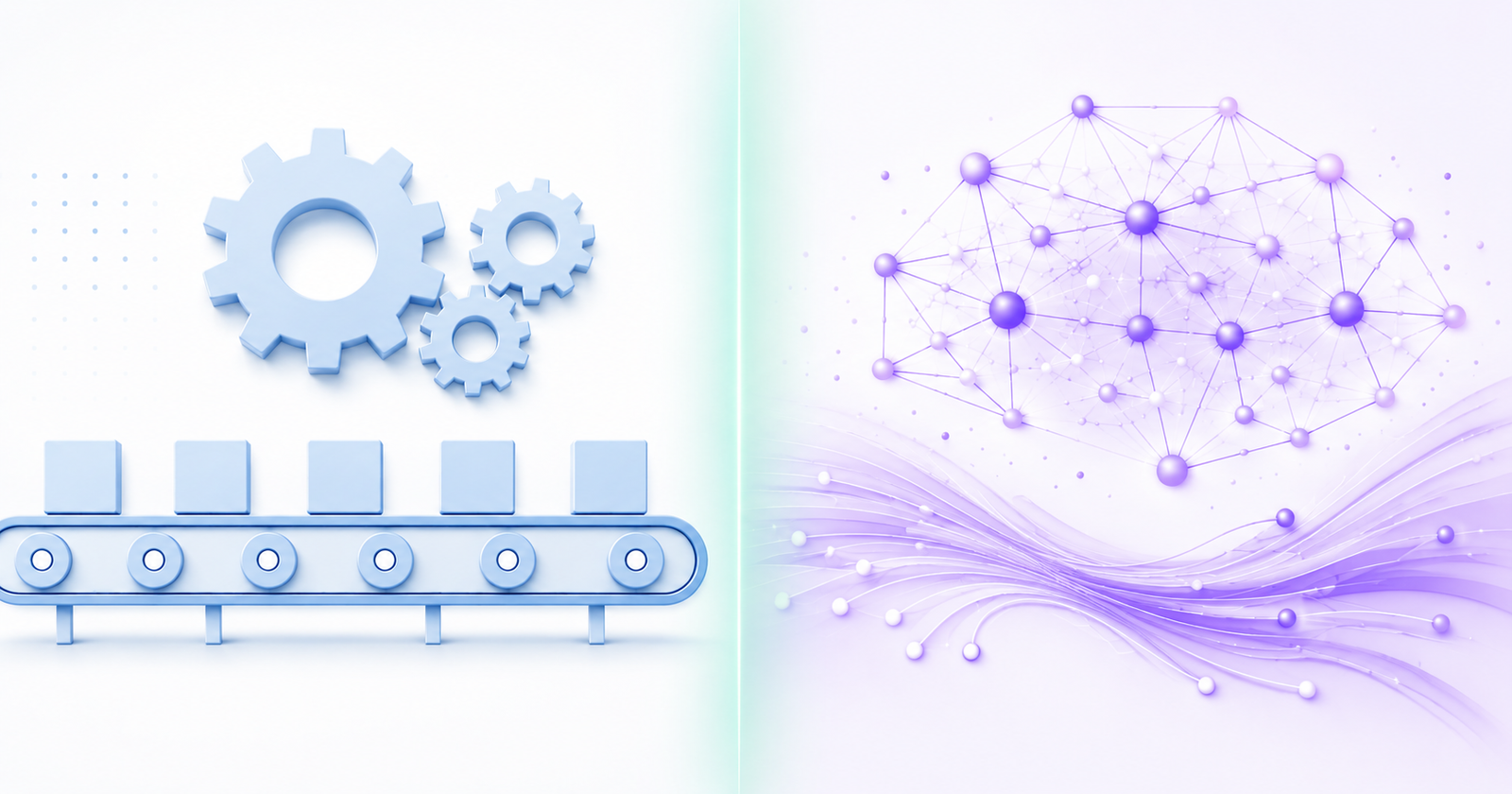
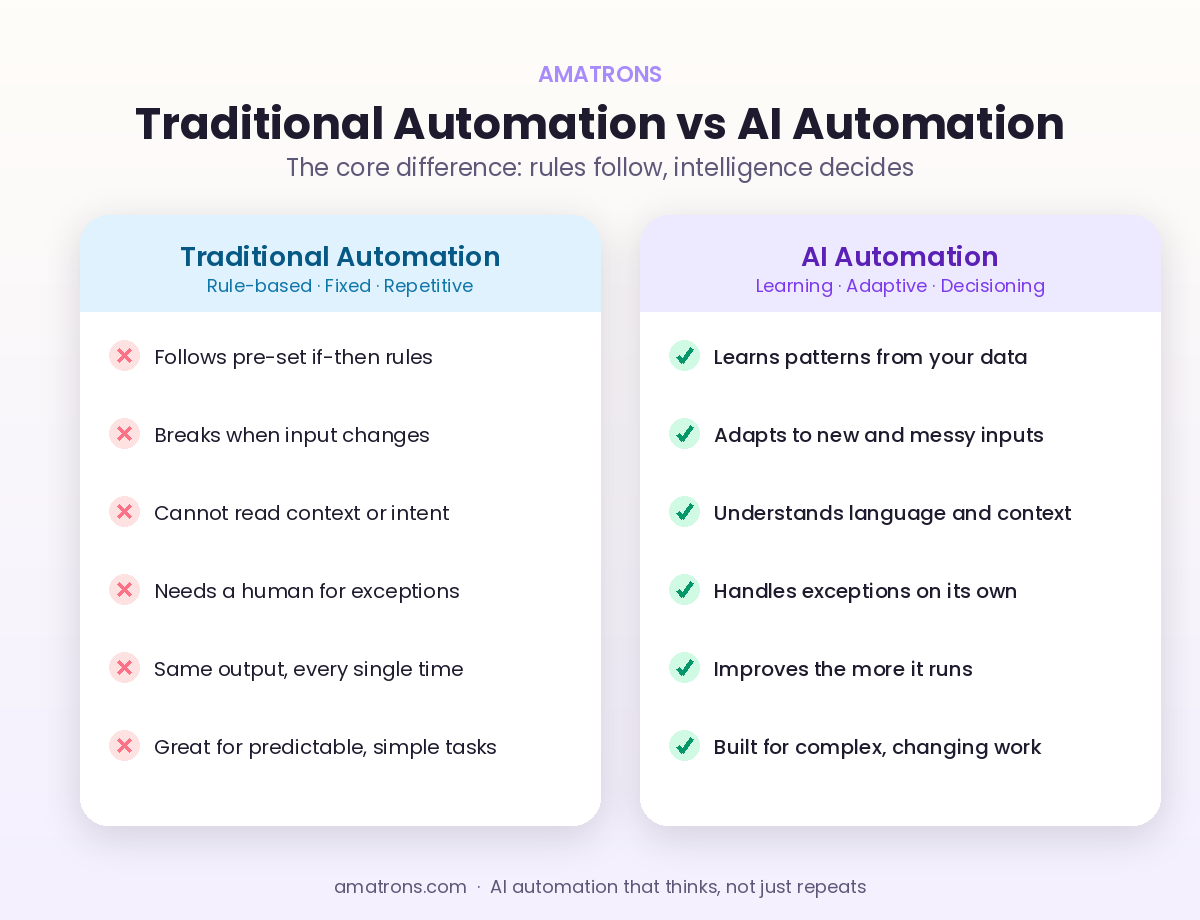
The clearest way to see the gap is side by side. Both move work forward without you, but they behave in opposite ways the instant a task turns unpredictable.
Traditional Automation
- Follows fixed, pre-set rules
- Breaks when inputs change
- You must anticipate every scenario
- Stays exactly as you built it
- Best for simple, repetitive tasks
AI Automation
- Learns from data and context
- Adapts to new and messy inputs
- Handles exceptions on its own
- Improves the more it runs
- Built for complex, changing work
Here is the same comparison across the factors that matter most when you are deciding where to spend.
| Factor | Traditional Automation | AI Automation |
|---|---|---|
| How it works | Follows fixed, pre-written rules | Learns from data, reasons about context |
| Handles new situations | No, it breaks or stops | Yes, it adapts on its own |
| Understands language | No, only exact matches | Yes, reads intent and tone |
| Improves over time | No, stays static | Yes, learns from every run |
| Setup cost | Low and quick | Higher, needs data and tuning |
| Best for | Simple, repetitive, predictable tasks | Complex, judgment-based tasks |
Notice that neither column is wrong. A reminder that goes out on a schedule does not need intelligence, and paying for AI to do it would waste money. A customer conversation, on the other hand, will defeat a rule-based bot within minutes. The skill is matching the tool to the task.
The Numbers: How Fast Businesses Are Moving to AI
This is not a trend you can watch from the sidelines. According to McKinsey’s State of AI 2025 report, 88% of companies now use AI in at least one business function, up from 78% the year before and just 55% in 2023.
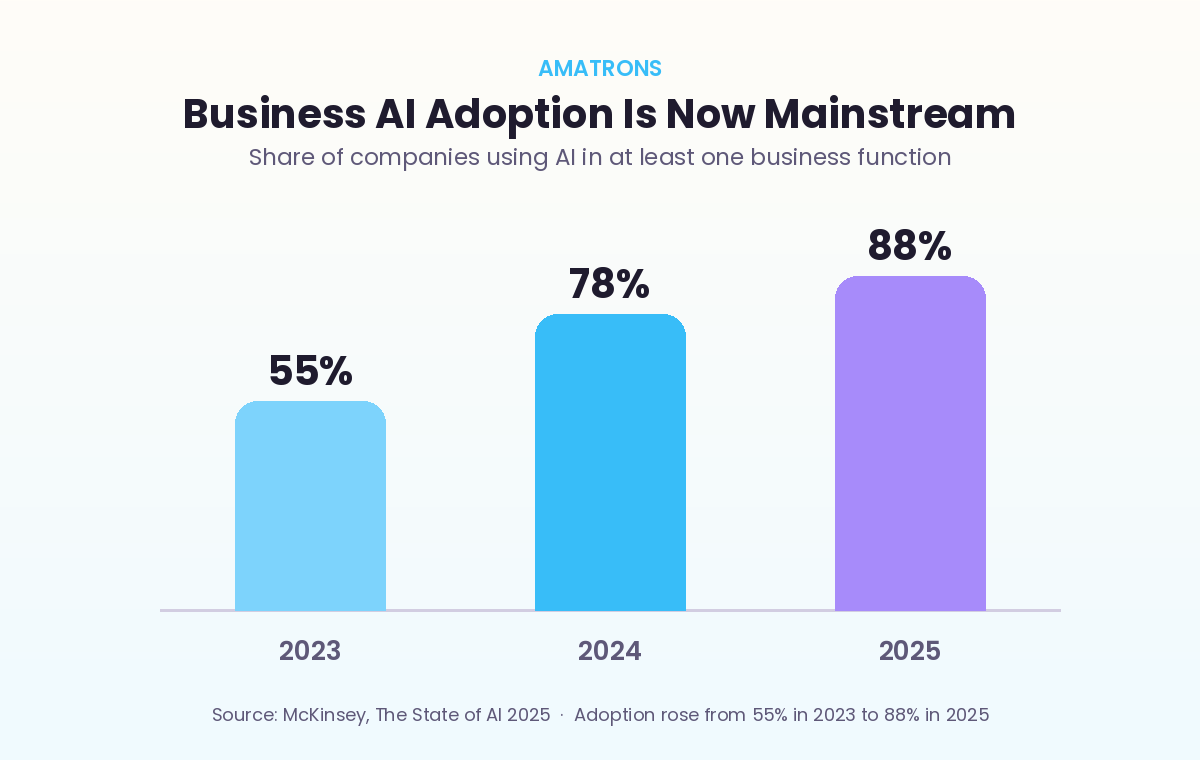
The more useful detail for a small business is hidden under that headline. Only about a third of companies have scaled AI across the organisation. Two thirds are still experimenting. That gap is your opening. While larger competitors get stuck in pilots and committees, a lean business that picks the right workflow and ships it can move faster and look more advanced than companies ten times its size.
When to Use Traditional Automation vs AI Automation
Here is the decision most people overthink. You do not pick a side. You pick per task. Run any job you want to automate through the test below before you spend a rupee or a dollar.
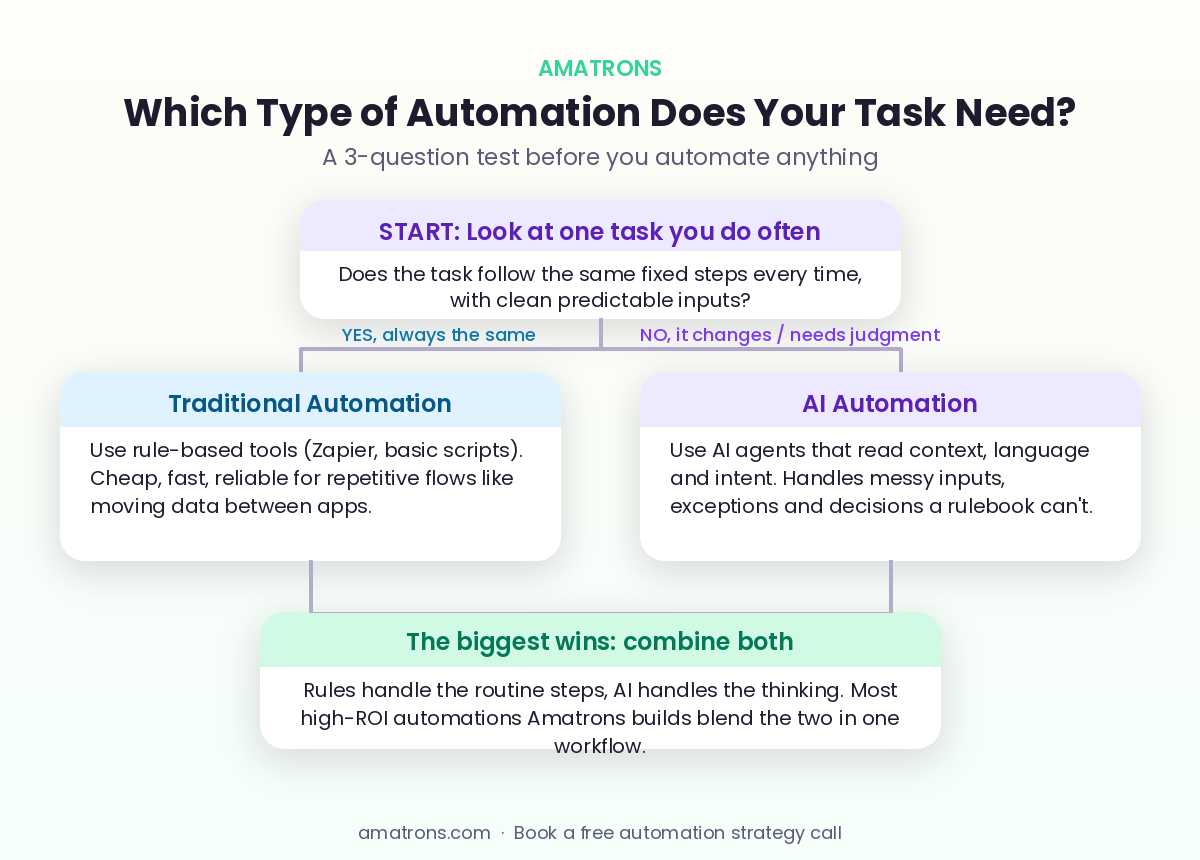
Use traditional automation when
- The task follows the same steps every single time.
- The inputs are clean and predictable, like a form field or a date.
- There is no language to interpret and no judgment to make.
- You need it cheap, fast, and running this week.
Good examples are syncing data between apps, sending scheduled reminders, generating invoices, and posting at fixed times. These are solved problems. Rules win here.
Use AI automation when
- The task involves reading or writing language, like emails, chats, or notes.
- Inputs are messy, varied, or arrive in formats you cannot predict.
- The right action depends on context or past behaviour.
- A human currently steps in to handle the exceptions.
Good examples are qualifying inbound leads, answering customer questions, summarising long documents, and personalising follow up. Rules collapse here. Intelligence is the only thing that holds up.
The biggest wins come from combining both
The mistake is treating this as either or. In practice, the highest return workflows blend the two. Rules handle the mechanical steps, capturing the lead, logging the data, sending the confirmation, while AI handles the part that needs a brain, reading the message, deciding the response, and writing it. This is what intelligent automation looks like when it is done well, and it is the kind of system worth building once and running for years. A perfect real-world example is welcoming a new client, which you can see laid out step by step in our guide on how to automate customer onboarding. Our workflow automation service is built around exactly this blend.
A Real Example: Lead Follow Up
Picture a coaching business getting twenty enquiries a week through a website form and WhatsApp. With traditional automation alone, every new lead gets the same template email and a fixed three step sequence. Better than nothing, but it treats a ready-to-buy lead exactly like a tyre kicker, and it ignores anything a person writes back.
- Rule: the form submission is captured and logged in the CRM instantly.
- AI: reads what the person actually wrote and scores how serious they are.
- AI: drafts a reply that answers their specific question in your tone.
- AI: decides whether to book a call now or nurture for later.
- Rule: the booking confirmation and onboarding documents go out automatically.
Same number of leads, completely different outcome. The rules give you speed and consistency. The AI gives you judgment at scale. That combination is how a solo founder responds like a full sales team without hiring one.
How to Move From Rule-Based to AI Automation
You do not rip out what you have. You upgrade the parts that are failing. Here is a practical path.
- List your repetitive tasks. Write down every task you or your team repeat each week. Be specific.
- Sort them with the three question test. Mark each one as rule-friendly or AI-friendly using the guide above.
- Automate the rule-friendly ones first. They are quick wins and they free up time immediately.
- Pick one high-value AI task. Choose the workflow where human judgment is the bottleneck, usually sales follow up or customer support.
- Build, test, and let it learn. Start small, check the output, and improve it. AI gets sharper the more real cases it sees.
If you want the full picture of how this fits together, start with our pillar guide on what AI automation is and how it works, then see how we deliver it through our AI automation service. The goal is never automation for its own sake. It is a business that runs cleaner, responds faster, and needs less of your time to keep moving.
Three Mistakes Businesses Make With Automation
Most automation fails for the same handful of reasons, and none of them are about the technology. They are about how the work was chosen and set up. Avoid these three and you are already ahead of companies spending far more than you.
Will AI Automation Replace Traditional Automation?
Short answer: no, and anyone telling you to throw out your rule-based tools is giving you bad advice. The two are not rivals fighting for the same job. They are different instruments for different problems, and a smart business keeps both in the toolbox.
Think about why rule-based automation has survived for decades while flashier technology came and went. It is dependable. When a task is fully predictable, a rule will run it perfectly for years at almost no cost, and you can trace every step if something looks wrong. AI cannot beat that on a task that never changes, and it would be more expensive to try. For the routine plumbing of a business, moving data, sending confirmations, scheduling posts, rules remain the right answer.
What is changing is the size of the territory each one owns. Until recently, anything that needed judgment, language, or context simply could not be automated, so a human did it. AI has pulled a huge chunk of that work into reach for the first time. So AI is not replacing traditional automation. It is expanding what automation can touch, taking on the messy, thinking-heavy jobs that rules were never able to handle.
The businesses that win are not the ones that bet everything on one approach. They are the ones that get clear about which tasks are mechanical and which need a brain, then route each to the tool built for it. That clarity, more than any single piece of software, is what turns automation from a gadget into a system that quietly runs your business in the background.
Frequently Asked Questions
What is the main difference between AI automation and traditional automation?
Traditional automation follows fixed rules you set in advance and cannot handle anything outside them. AI automation learns from data and reads context, so it adapts to new situations, understands language, and makes decisions on its own.
Is AI automation more expensive than traditional automation?
AI automation usually costs more to set up because it needs data and tuning, while rule-based automation is cheap and quick. But AI delivers far higher value on complex tasks, which is why businesses use rules for simple work and AI where judgment is needed.
Can small businesses use AI automation?
Yes. AI automation is now affordable and accessible for small businesses through no-code tools and AI agents. With 88% of companies already using AI in at least one function, small firms that adopt it early often look more advanced than far larger competitors still stuck in pilots.
What is the difference between AI automation and RPA?
RPA, or robotic process automation, mimics human actions on screen like clicking and copying data between systems. AI automation understands context, reads unstructured data, and makes decisions. RPA is a very fast typist. AI automation is a fast, intelligent assistant.
Should I replace my existing automation with AI?
No. Keep the rule-based automation that works well for predictable tasks and add AI only where human judgment is currently the bottleneck, such as lead follow up or customer support. The best results come from combining both in one workflow.
The Bottom Line
The choice between AI automation vs traditional automation is not about which is better. It is about which is right for the job in front of you. Rules are perfect for the predictable, repetitive work that should never need your attention again. AI is built for the messy, language-heavy, decision-driven work that used to demand a human. Map your tasks to the right tool, combine the two where it counts, and you build something rare: a business that handles its own busywork and still makes smart calls at scale. Start with the task that is eating the most time, and grow from there.