Search for the best AI sales tools and you will drown in lists pushing enterprise software built for hundred person sales teams. Gong, Salesforce Einstein, ZoomInfo. Powerful, expensive, and almost completely wrong for a coach or consultant running a lean practice. You do not need a sales war room. You need a few smart tools that quietly fill your calendar while you do the work you actually love.
This guide is different. Instead of ranking 20 tools you will never use, it organizes the best AI sales tools for coaches by the job each one does in your funnel. Capture leads, book the call, stay organized, follow up, and show up prepared. Pick the one that fixes your biggest bottleneck first, add others later, and ignore the rest.
One number to set the stage. Sales professionals spend around 72 percent of their time on non selling work like data entry, scheduling, and chasing follow ups. For a solo coach who is also the marketer, the deliverer, and the admin, that ratio is even worse. Every tool below exists to win that time back.
The coach sales stack, by job
Before naming tools, get the map clear. A coaching practice has six jobs in its sales funnel, and there is a category of AI tool for each. You do not need all six on day one. You need the one that plugs your worst leak.
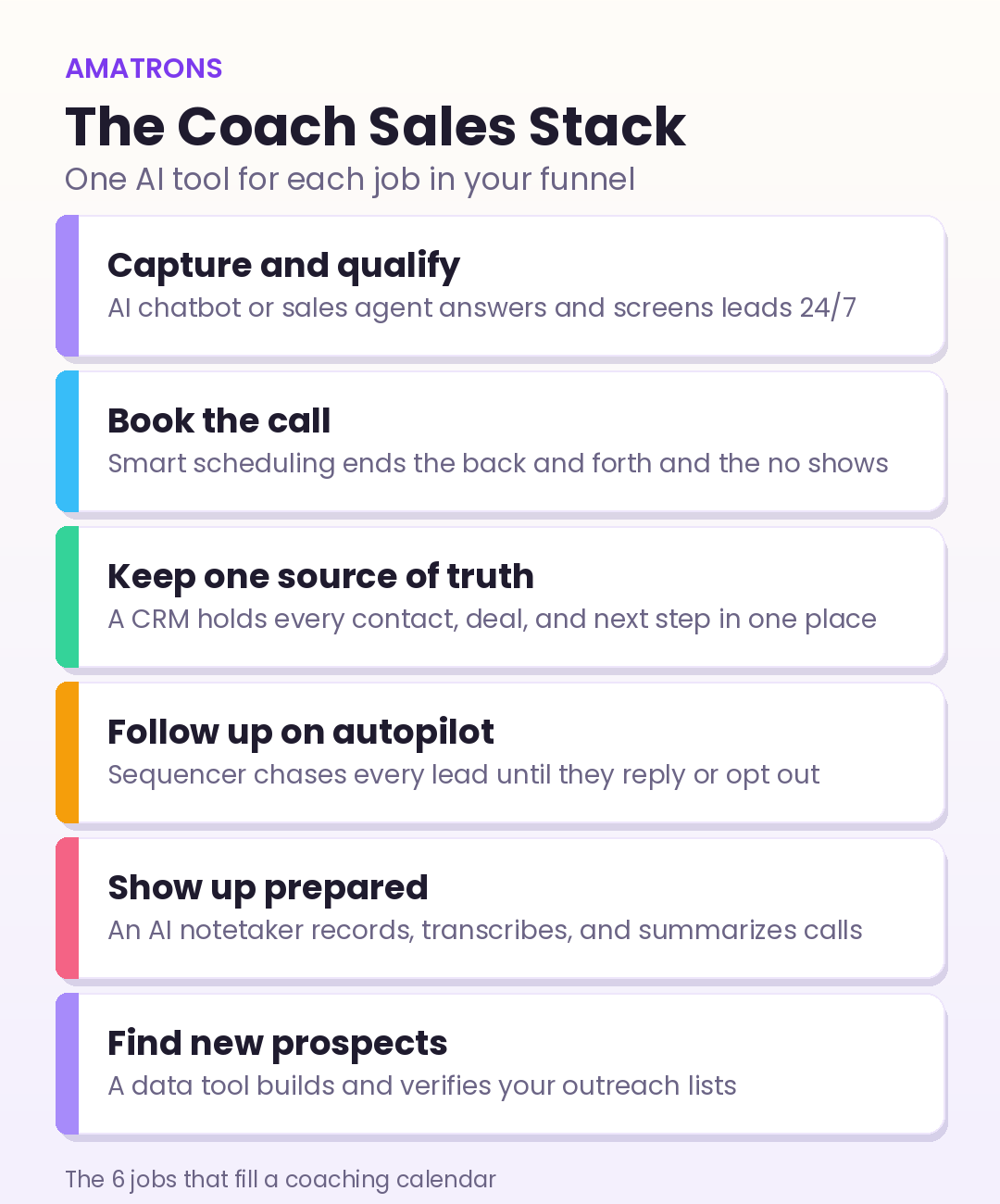
Now the tools, category by category. For each, I will tell you what it does, who it fits, and when to skip it.
1. Capture and qualify leads 24/7
This is the highest leverage tool for most coaches, because the leak here is the most expensive. Someone lands on your site at 10pm, fills a form or starts a chat, and then waits. By the time you reply the next morning, they have moved on. An AI chatbot or sales agent fixes this by replying instantly, answering common questions, qualifying the lead, and booking the call, all without you.
Tools to look at: CloseBot and similar AI booking bots are built specifically for service providers. For something more capable that holds a real conversation and qualifies properly, a full AI sales agent goes further than a basic chatbot. If you are unsure which you need, our comparison of an AI sales agent versus a chatbot spells out the difference clearly.
2. Book the call without the back and forth
Scheduling chaos kills momentum. The classic, what time works for you, well not then, how about Tuesday, exchange loses warm leads and creates no shows. A smart scheduling tool sends a link, the prospect picks a slot, and reminders go out automatically.
Tools to look at: Calendly is the standard for a reason, with a free tier and AI scheduling features that route leads and cut no shows. Most coaches never need anything fancier. This pairs naturally with the capture tool above, so a qualified lead gets booked in the same flow without you touching it.
3. Keep one source of truth with a CRM
If your leads live in your inbox, your DMs, and your memory, you are losing sales you already earned. A CRM is the single place every contact, conversation, and next step lives. In 2026 they come with AI sprinkled throughout, like lead scoring and email writing help.
Tools to look at: HubSpot is the gold standard and its free tier is one of the best in the business, giving coaches contact management, email, deal tracking, and scheduling in one place. Start free, upgrade only when you outgrow it.
4. Follow up automatically, because most sales hide there
Most sales are lost in the follow up that never happens. An email sequencer sends your follow ups on schedule, on every lead, until they reply or opt out. Add an AI writing assistant and each message gets sharper without sounding like a robot wrote it.
Tools to look at: Instantly or Apollo for sequencing, paired with Lavender, an AI email coach at around $29 a month that pulls in context and makes your emails far more likely to get a reply. If you would rather not assemble this yourself, this is exactly the work an AI voice agent or sales agent handles on autopilot. For the full method, see our guide on why AI is outperforming human only outreach in 2026.
5. Show up prepared with an AI notetaker
You are on a discovery call. Instead of scribbling notes and missing what the client actually says, an AI notetaker records, transcribes, and summarizes the call, then drops the action items into your CRM. You stay present, the admin handles itself.
Tools to look at: Fathom and Fireflies both have genuinely useful free tiers. For a coach, the value is staying fully present in the conversation, which is the whole point of coaching, while never losing a detail or a follow up commitment.
6. Find new prospects when inbound is not enough
If you have exhausted your network and referrals, you need a way to find and reach new people. A prospecting data tool builds targeted lists and verifies contact details so you are not emailing dead addresses and wrecking your sender reputation.
Tools to look at: Apollo.io has a usable free tier for finding prospects that match your ideal client. Be disciplined here. Bad targeting and unverified lists do more harm than good, so this tool is only worth it once your capture, booking, and follow up are already running well.
What it actually costs, lean versus overkill
Here is where the honest coach in me overrides the marketing. You can build a complete, working AI sales stack for somewhere between free and about $80 a month using free tiers and one or two paid tools. The enterprise bundles those other lists push run into thousands a month and are built for problems you do not have.
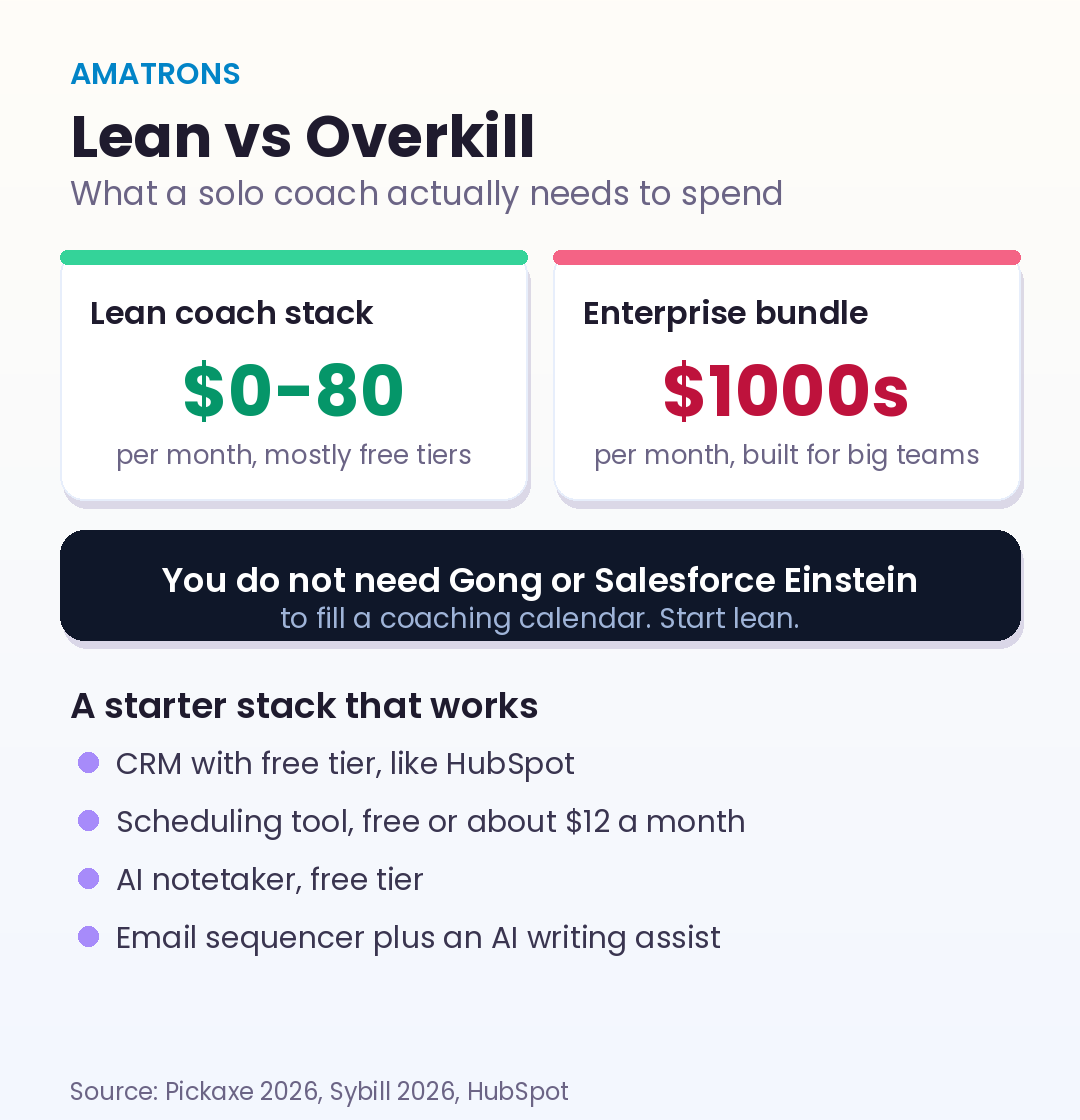
A starter stack that works: a CRM on a free tier, a scheduling tool that is free or around $12 a month, a free AI notetaker, and an email sequencer with an AI writing assist. That is it. Add the AI capture agent the moment you have steady inbound to justify it. Resist the urge to buy the shiny enterprise platform. It will sit unused while you pay for it.
How to choose: match the tool to your bottleneck
Do not buy a stack. Buy the one tool that fixes the leak costing you the most right now. Diagnose honestly, then act.
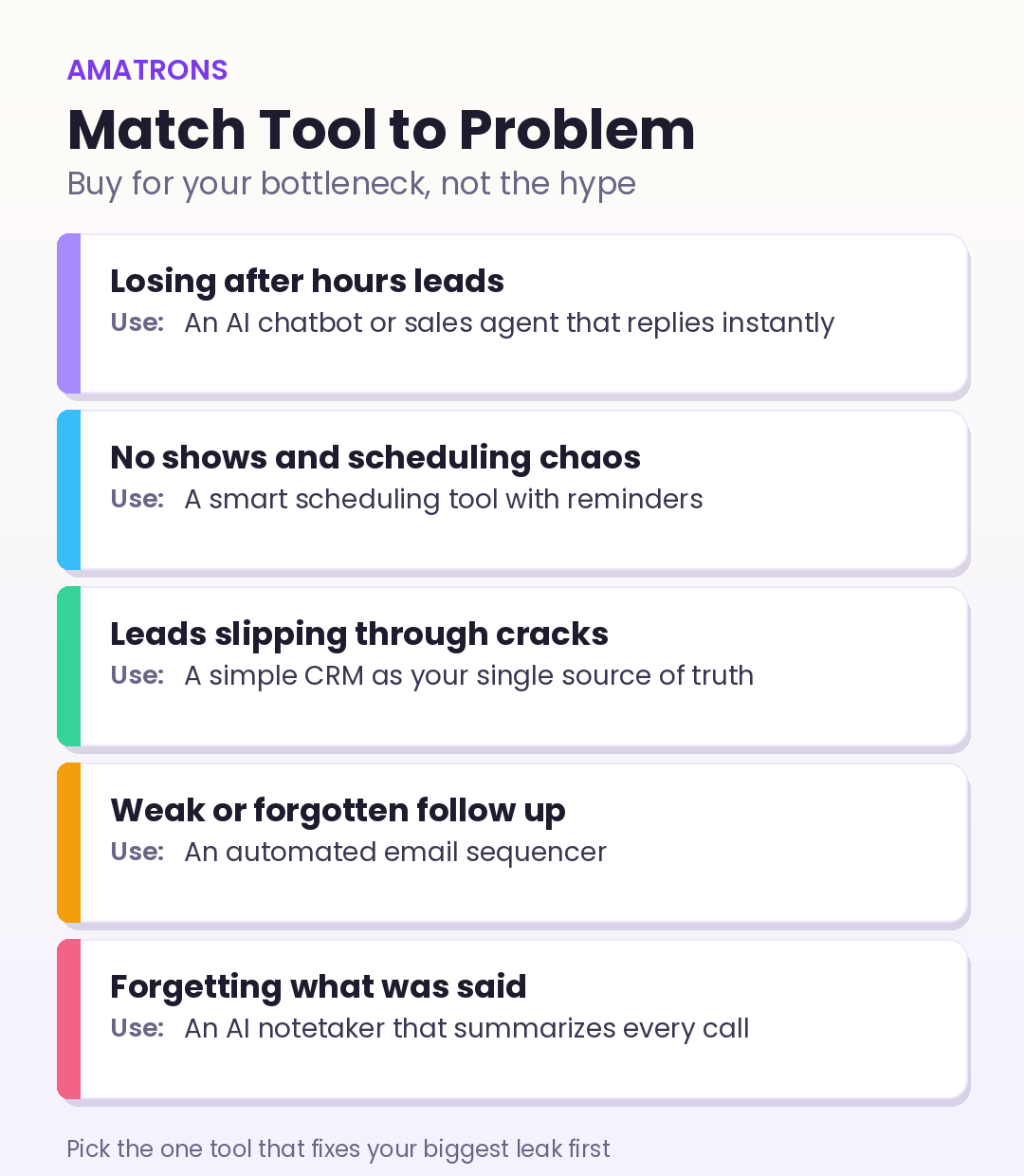
If you are losing after hours leads, start with an AI capture agent. If your problem is no shows and scheduling mess, fix that first. Leads slipping through the cracks means you need a CRM before anything else. Weak follow up calls for a sequencer. And if you keep forgetting what was said on calls, get a notetaker. One tool, one fix, then reassess.
The deeper point is that tools are not a strategy. They are leverage on a strategy you already have. The same principle runs through all good AI automation for a business: automate the proven, repetitive work, and never automate confusion. A tool will amplify whatever system you feed it, good or bad.
Why this matters more for coaches than anyone
A big sales team can absorb wasted time because it has bodies to throw at the problem. You cannot. When you are the entire business, every hour lost to admin is an hour not spent coaching, selling, or resting. Research compiled by Guideflow found sales professionals spend roughly 72 percent of their time on non selling activities. For a solo coach wearing every hat, that drag is the single biggest cap on how much you can earn.
This is the real argument for AI sales tools, and it has nothing to do with being trendy. It is about reclaiming the hours that repetitive work steals. A capture agent saves the morning you would spend replying to overnight enquiries. A scheduler saves the email tennis. A sequencer saves the follow ups you forget when client work takes over. Stack those saved hours and you get the one thing a coach can never buy more of, time to do the high value work only you can do.
There is a quieter benefit too. Consistency. A tired human follows up unevenly, replies slowly on busy days, and lets warm leads cool. Software does not have busy days. It treats the lead who came in on your worst week exactly as well as the one who came in on your best. That reliability, more than any single feature, is what steadily lifts a coach’s conversion rate over time.
What to skip, honestly
You will be pitched conversation intelligence platforms like Gong, predictive CRM suites like Salesforce Einstein, and enterprise data tools like ZoomInfo. They are excellent products. They are also built for sales teams with managers coaching a dozen reps, and they are wasted money for a solo coach or a small consulting practice. Skip them until you genuinely have a team to manage. By then you will know, because the lean stack will have filled your calendar first.
The honest bottom line
The best AI sales tools for coaches are not the most powerful ones. They are the ones that quietly remove the non selling work so you can spend your time coaching and closing. Start with the single tool that fixes your worst leak, keep your spend lean, and only add the next tool when the last one is paying off.
Pick one this week. Set it up, let it run, and measure whether your calendar fills. That beats reading another tool list by a mile. When you want the capture, qualify, and follow up pieces built into one system done for you, our AI sales agent service handles it end to end so you can stay focused on your clients.