Here is the most expensive habit in your business, and you probably do not even notice it. A lead comes in, you reply once, maybe twice, and then life takes over. Client work, the next fire, the school run. The lead goes quiet, you assume they were not serious, and you move on. That lead was not unserious. They were just busy, and you stopped showing up before they were ready to buy.
This is not a minor leak. It is where most sales die. The data is blunt: 80 percent of sales require five or more follow ups to close, yet 44 percent of reps give up after a single attempt, according to RAIN Group research, and only about 8 percent ever reach that fifth touch. Most businesses are abandoning the majority of their winnable deals right before the point where they would have converted.
The good news is that this is not a talent problem or a charisma problem. It is a systems problem, which means it can be fixed with a system. This guide shows you exactly how to use AI to follow up with every lead automatically, so the deals you already paid to generate stop slipping away.
Why follow up is where the money leaks out
Before the how, look at the size of the prize, because it reframes everything. Following up is not pushy admin work. It is the highest return activity in your entire funnel, and almost nobody does it properly.
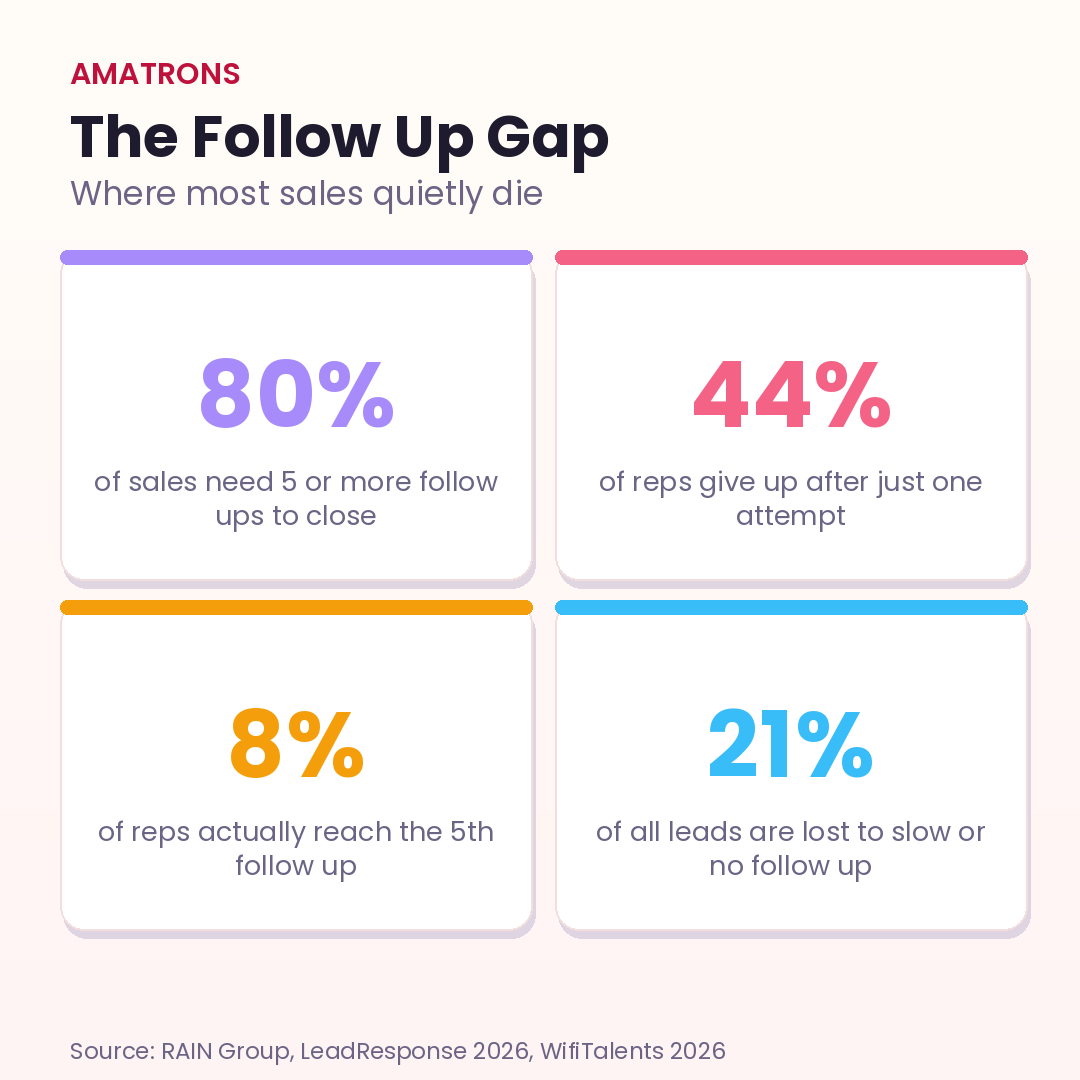
Sit with those numbers. The average sales rep makes just 1.3 attempts to reach a prospect before moving on. Meanwhile 95 percent of converted leads are reached around the sixth attempt, and 63 percent of people who request information will not buy for at least three months. The lead is not dead, your follow up is. And 21 percent of all leads are lost purely to slow or absent follow up, a tax you are paying on every marketing dollar you spend.
Speed compounds the effect. Harvard Business Review research on millions of leads shows those contacted within five minutes are far more likely to convert than those reached even thirty minutes later, and over half of sales go to whoever responds first. A human cannot watch the inbox every minute or remember to send the sixth message six weeks later. Software can. That is the entire case for automating this.
What AI lead follow up automation actually is
AI lead follow up automation is a system that contacts every new lead instantly and keeps following up across channels, on a schedule, adapting to how the lead behaves, until they reply, book, or opt out. It removes the three things that cause humans to drop the ball: memory, willpower, and free time.
In plain terms: it is a tireless assistant that never forgets a lead, never gets discouraged by silence, and never gets too busy. It is one of the most valuable jobs handled by a full AI sales agent, and it is usually the fastest part of a sales process to automate.
This is different from a basic autoresponder that fires the same email to everyone. A modern AI system personalizes each message, switches channels when one is not working, and reacts to signals like an opened email or a clicked link. It behaves less like a robot and more like a diligent rep who happens to never sleep.
How the system works, step by step
Under the surface, an AI follow up system runs a simple, reliable loop on every single lead. Once you understand the flow, building it is straightforward.
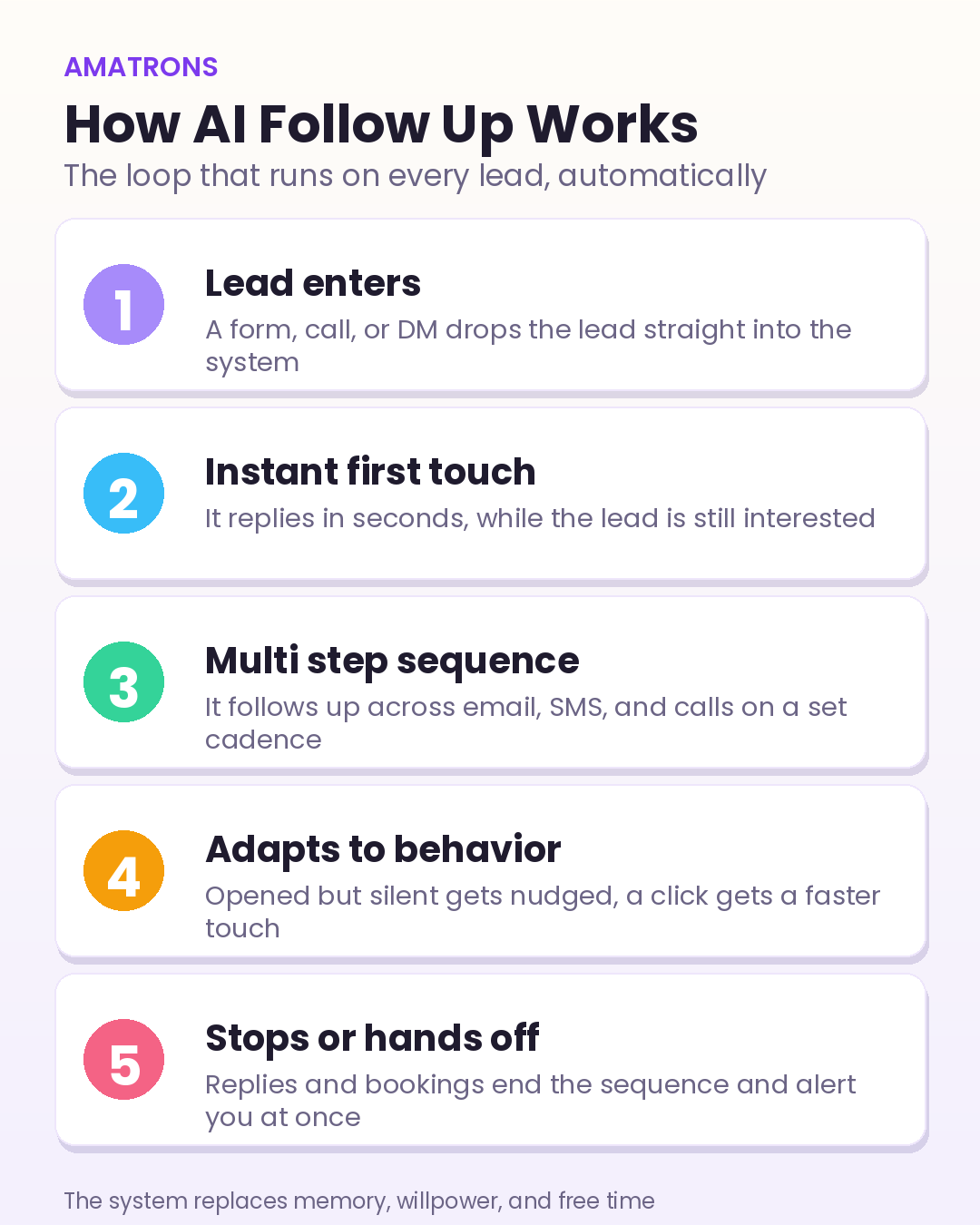
It starts the moment a lead enters, from a form, a call, or a DM, dropping straight into the system. The first touch fires in seconds, while interest is still hot. From there a multi step sequence runs across email, SMS, and calls on a set cadence. The system adapts to behavior, nudging the lead who opened but stayed silent and moving faster on the one who clicked. And it stops or hands off the instant the lead replies or books, alerting you so a human takes the conversation from there.
That handoff is the key to keeping it human. The AI does the relentless chasing that people hate and fail at. You step in for the actual conversation, which is where deals are won. Wiring the trigger, the sequence, and the CRM updates together is mostly a workflow automation job, and it is the same backbone behind any reliable lead system.
How to set it up in five steps
You do not need a developer. Here is the build, in order.
- Connect your lead sources. Point every place leads come in, your forms, ads, chat, and calls, into one system so nothing arrives unseen.
- Write your sequence once. Draft five to eight messages that each add value. AI can help you draft them, but you set the voice and the offer.
- Set the cadence and channels. Decide the timing and which channel each touch uses. The next section gives you a proven default.
- Add the rules. Tell it to stop on a reply or booking, and to alert you when a lead goes hot. This prevents the awkward chasing of someone who already said yes.
- Test, launch, and measure. Run yourself through it first, then go live and watch replies and booked calls climb.
This is the same disciplined approach behind a full AI sales agent setup: start with one clean workflow, get it right, then expand. If you want it to also place live calls rather than only send messages, an AI voice agent slots into the same sequence.
The follow up cadence that actually converts
The most common question is how often to follow up without becoming annoying. The data points to five to eight touches over roughly fourteen to twenty one days, spread across more than one channel. Here is a default cadence you can copy.
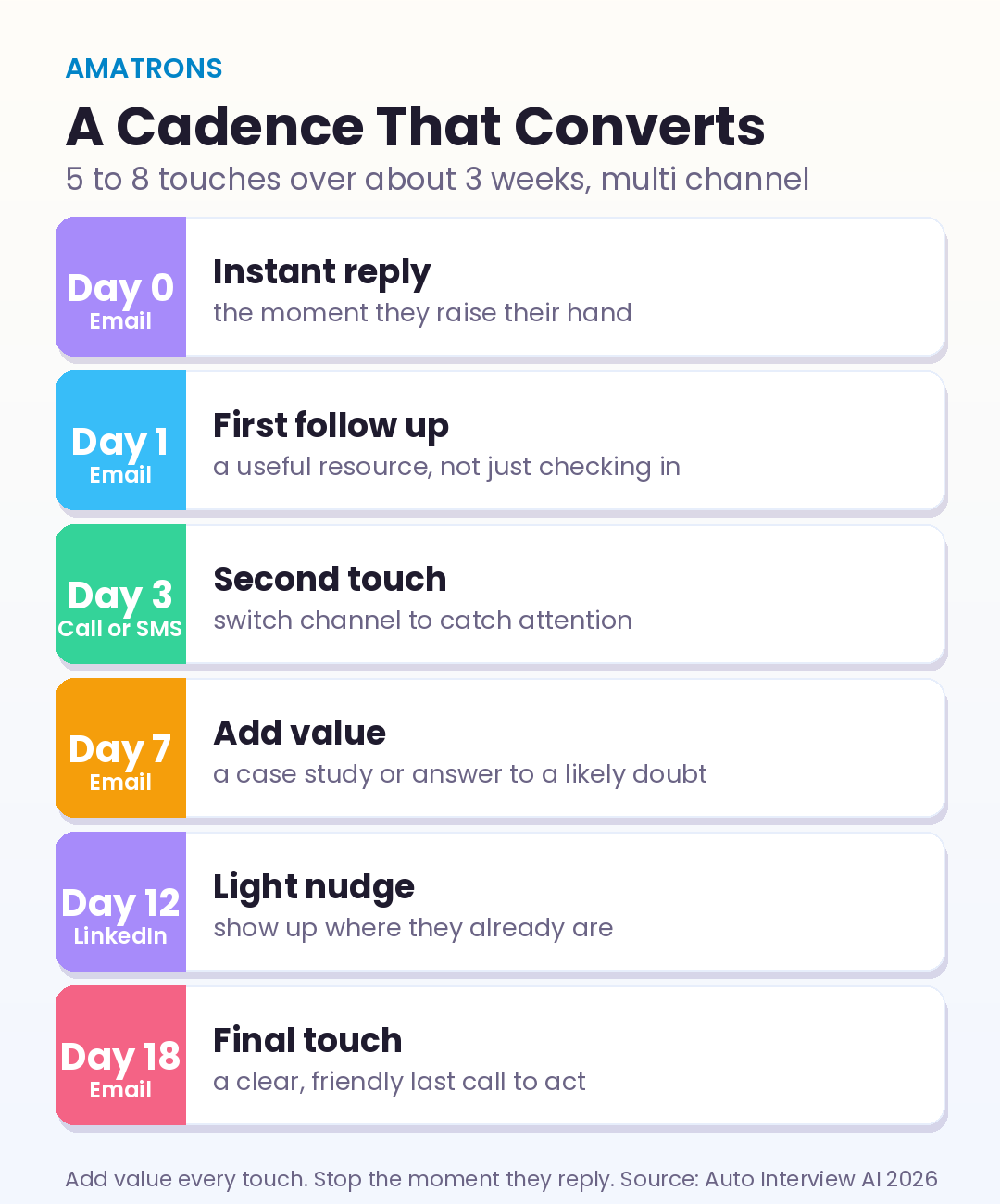
Notice two things. First, it switches channels. A prospect who ignores email might answer a text or a LinkedIn note, and multi channel follow up consistently outperforms single channel. Second, every touch adds value. The fastest way to get blocked is to send a string of “just checking in” messages. Each contact should offer something useful, a relevant resource, an answer to a likely objection, a genuine reason to reengage.
The rules that keep you out of the spam folder
Automation done badly is just faster annoyance. A few rules keep your follow up effective and your reputation intact. Always lead with value, never with pressure. Stop the sequence the instant someone replies or books, because nothing kills trust like being chased for something you already agreed to. Respect opt outs immediately. And keep your messages short and human, because the moment a sequence reads like a robot wrote it, people tune out.
Get those right and persistent follow up does not feel pushy to the prospect. Remember, they are not ignoring you because they dislike you. They are ignoring you because they have a hundred other emails and three meetings today. Your well timed, useful follow up is a helpful reminder, not a nuisance.
What you can realistically expect
When you close the follow up gap, the gains do not come from new leads. They come from converting more of the leads already sitting in your pipeline. Companies using automation to ensure consistent follow up are dramatically more likely to qualify a lead than those relying on human memory, and the lift shows up fast because the leads already exist. You are not working harder. You are simply stopping the leak.
This is also why follow up automation pairs so well with strong outreach. If you are generating interest through cold channels, our guide on why AI outperforms human only outreach in 2026 covers the front of the funnel, and this system makes sure none of those hard won leads die from neglect once they arrive.
Why doing this manually always breaks down
You might be thinking you will just be more disciplined. Set reminders, block time, stay on top of it. Every busy operator believes this, and almost every one fails, not from laziness but from how the work actually unfolds. Follow up competes with the thing that pays you right now, which is delivering for current clients. When a deadline hits, the lead you were nurturing quietly drops to the bottom of the list. Then it is forgotten.
That is the trap. The reward for good follow up is weeks away and invisible, while the pressure of today’s work is immediate and loud. Human attention always bends toward the loud and urgent, so the patient, valuable follow up is the first casualty every single time you get busy. The fear of seeming pushy makes it worse, so most people stop after one polite attempt and tell themselves the lead was not interested.
A system does not have busy days, does not feel awkward, and does not forget. It treats the lead who came in during your worst week exactly as well as the one who came in during your calmest. That consistency, more than any clever message, is what quietly lifts your conversion rate. You are not trying to become a more disciplined human. You are removing the need to rely on discipline at all.
The honest bottom line
You are almost certainly losing sales right now, not because your offer is weak, but because following up consistently is genuinely hard for a busy human to sustain. That is not a flaw in you. It is a flaw in doing it manually. The fix is a system that follows up on every lead, on time, across channels, until they decide, then hands the warm ones to you.
Set it up once and it runs forever, quietly recovering the deals you were leaving on the table. If you would rather have the whole capture, follow up, and booking system built and running for you, our AI sales agent service handles it end to end so no lead ever falls through the cracks again.