Every business owner asks the same question before spending a rupee or a dollar on AI: will this actually pay off? It is the right question. The hype around automation is deafening, and most of it skips the part you care about, the money. So let us cut through it. This guide lays out the real ROI of AI automation using hard numbers from real studies and real businesses, including what companies get back per dollar, how long it takes, and the uncomfortable truth about why so many projects return nothing at all.
By the end you will know the average return to expect, which automations pay back fastest, how to estimate your own numbers, and the exact reasons some businesses win big while others waste their budget. No hype, just the figures and what they mean for you.
What Is the Real ROI of AI Automation?
Here is the headline number. According to a large global study by IDC, commissioned by Microsoft, companies earn an average of $3.70 back for every $1 they invest in AI, and the top performers pull in as much as $10. Most businesses start seeing that return within about 14 months of going live.
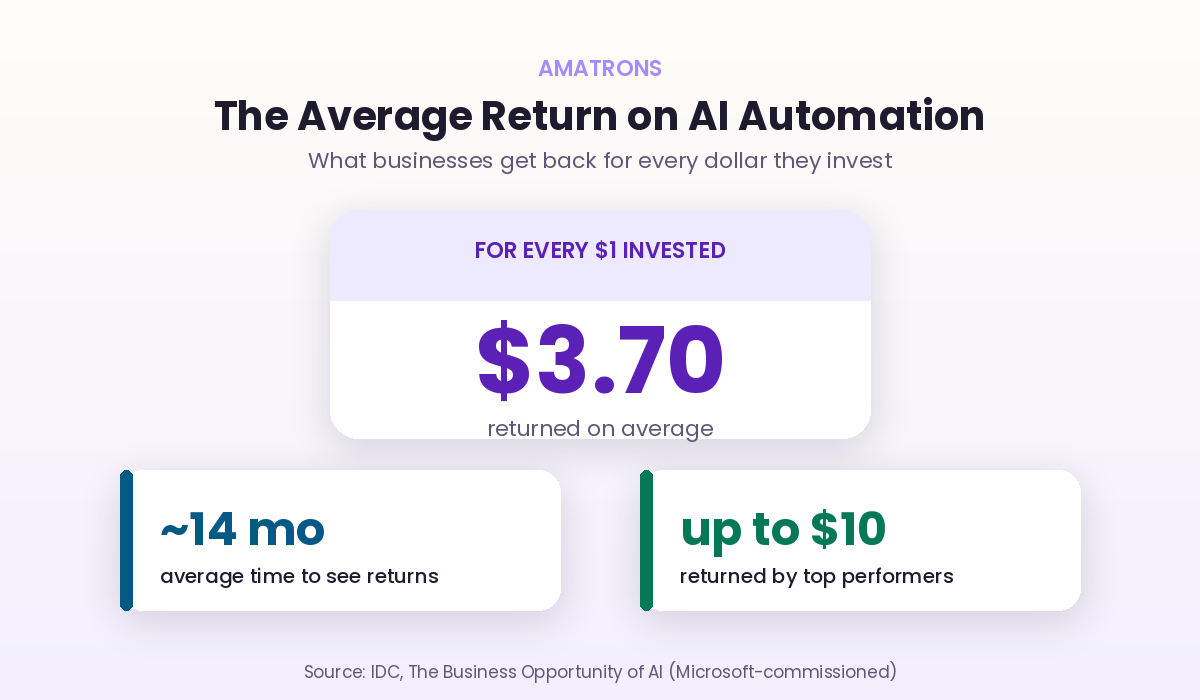
That is a 270% return, which beats almost any other investment a small business can make. You can read the full findings in the Microsoft and IDC report. The study also found that 92% of AI deployments now go live in under a year, far faster than older business technology ever did.
But that average is where most articles stop, and that is exactly where they mislead you. The real story is hiding underneath it.
The Average Hides Two Very Different Stories
An average return of $3.70 sounds like a guarantee. It is not. That number is the middle point between businesses that struck gold and businesses that lost their money entirely. The gap between the two is enormous.
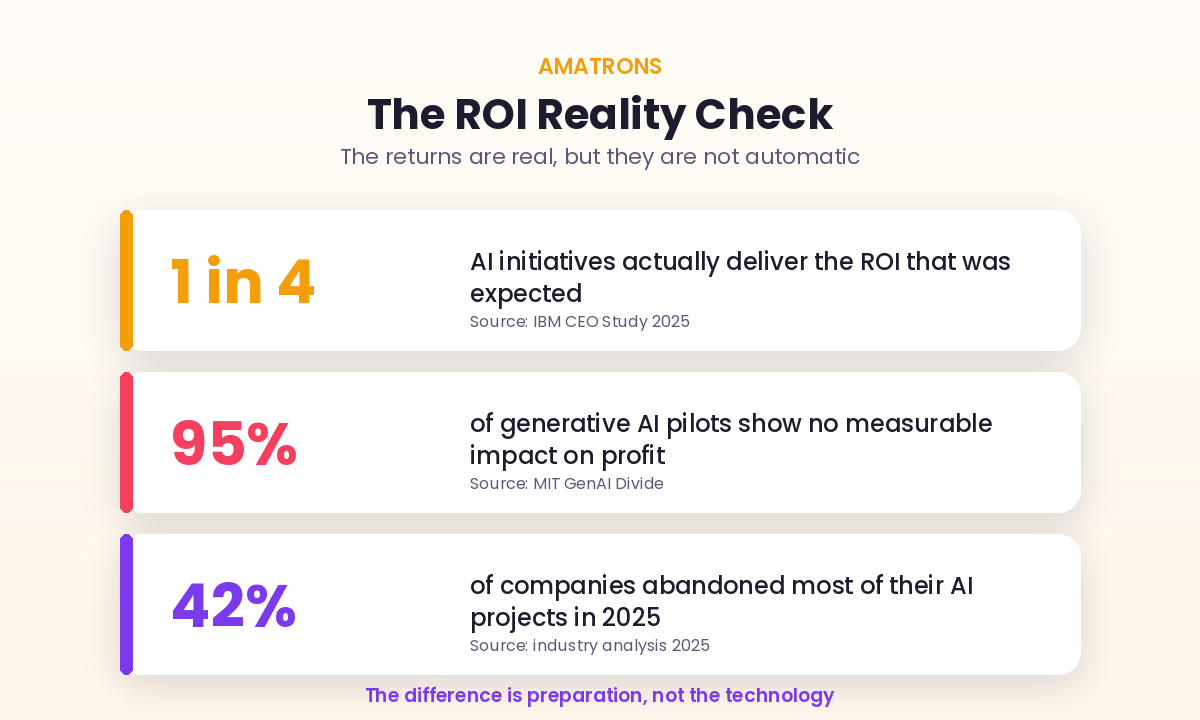
The sobering side of the data is just as well documented as the wins. IBM’s 2025 study of CEOs found that only one in four AI initiatives actually delivered the return that was expected. MIT’s research went further, reporting that 95% of generative AI pilots showed no measurable impact on the bottom line. And across the wider market, a large share of companies quietly abandoned most of their AI projects last year.
Read that carefully, because it is the most important point in this entire guide. The technology is not the problem. The same tools that return $3.70 for one business return nothing for another. The difference is not the software. It is preparation, the right use case, and disciplined execution. Get those right and you land in the winners’ column. Skip them and you become a statistic.
Where AI Automation Delivers the Fastest ROI
Not all automations pay back at the same speed. Some return their cost in weeks, others take the better part of a year. If you want a quick win that funds the next project, start where the payback is fastest and the inputs are cleanest.
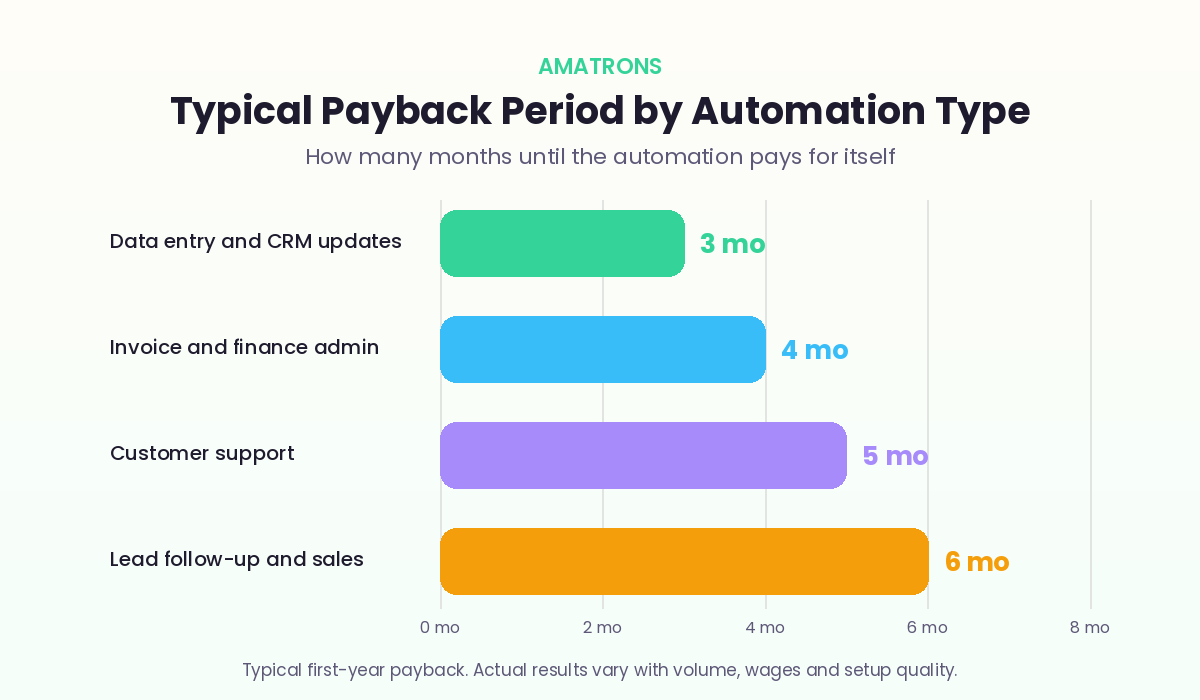
Data entry and CRM updates tend to pay back fastest, often within a few months, because they are cheap to build and remove hours of dull manual work immediately. Invoice and finance admin follow close behind. Customer support and lead follow up take a little longer to tune but deliver larger returns once they hit their stride. The pattern is simple: high volume plus clear inputs equals fast payback. If you want a fuller menu of options, our guide on the business processes to automate with AI breaks down the time savings for each one.
Real Numbers from Real Businesses
Averages are useful, but specifics are convincing. Here are documented results from real implementations, so you can see what the returns actually look like in practice.
A study of 247 organisations that automated financial processes reported a median return of 150% in the first year, driven by accuracy gains above 95% and processing time cut by as much as three quarters. In customer service, a Forrester analysis found modelled customers reaching 210% return over three years, with payback in under six months. One UK software company that added AI lead scoring watched its sales cycle shrink from 45 days to 28, a 38% drop that put cash in the door far faster.
The thread running through every one of these is volume and repetition. The more often a task runs, the more each automated hour is worth, and the faster the investment pays for itself. This is the same blend of rules and intelligence we covered in our breakdown of AI automation versus traditional automation, applied to the jobs where the money actually is.
How to Calculate Your Own AI Automation ROI
You do not need a finance degree to estimate this. The basic formula is straightforward, and a rough number on paper is far better than a guess in your head.
Here is a real example. Say a task eats 10 hours a week and the person doing it costs you $25 an hour. That is 10 × 25 × 52, which equals $13,000 a year in recovered time. If the automation costs $2,000 to build and $1,200 a year to run, your first-year cost is $3,200. You save $13,000 and spend $3,200, so you keep almost $9,800 in year one, and far more every year after that since the build cost is paid only once.
Run this quick sum on your two or three most repetitive tasks before you build anything. It tells you instantly which automation to start with, and it gives you a number to measure against once it is live. Remember to count more than just time. Faster response to leads, fewer errors, and quicker payment collection all add real money that a pure hours-saved figure misses.
Why Most Businesses Leave ROI on the Table
If the returns are this good, why do so many projects fail? Almost never because of the technology. The failures are predictable and, better still, avoidable. Here are the four that drain the most money.
- They automate a broken process. Automation makes things faster, including mistakes. A messy process automated is just a faster mess. Fix the steps first, then automate the clean version.
- They pick the wrong use case. Chasing a flashy project instead of a high-volume, repetitive one. The boring tasks are where the money is.
- They never define success. Without a target number, you cannot tell if it worked. The businesses that struggle to prove ROI usually never set a baseline to measure against.
- They set it and forget it. AI improves with tuning in the early weeks. Walk away too soon and it drifts instead of compounding.
Notice that every one of these is a planning problem, not a software problem. That is genuinely good news, because planning is something you control. The businesses pulling $3.70 and more from every dollar are not using better tools than everyone else. They simply chose the right task, fixed it first, set a clear goal, and refined as they went. If you want to understand the foundation behind all of this, our complete guide on what AI automation is and how it works covers the fundamentals, and our AI automation service exists precisely to help you skip these failure modes and land in the winners’ column from day one.
What AI Automation Actually Costs
Return means nothing without the other side of the equation, so let us talk about what you actually spend. The good news is that costs have fallen sharply. Industry analysis shows the price of getting started has dropped by more than half since 2024, while the tools have only grown more capable.
For most small businesses, the spend falls into three tiers. Simple automations built on no-code tools can run from $20 to $50 a month. A complete automation stack covering several workflows usually sits between $100 and $300 a month, which most businesses recover in the first week through time saved alone. Custom AI agent systems, the done-for-you kind that handle full end to end processes, are typically priced as a one-time build fee plus a smaller monthly cost to run.
The mistake is to look only at the monthly tool price. The real cost of any automation is the build, the setup, and the tuning, not the subscription. A tool that costs $30 a month but takes you 40 hours to configure is not cheap. This is why the cost side and the return side have to be weighed together, against the specific task you are automating, rather than judged on the sticker price of the software.
The Returns You Cannot Put in a Spreadsheet
The dollar figures are only half the picture. Some of the biggest returns from AI automation never show up cleanly in a payback calculation, yet they often matter more to the long-term health of the business.
Speed is the clearest one. When a lead gets a reply in 90 seconds instead of a day, you win deals you used to lose, because most buyers reward the first business to respond. Consistency is another. An automated process delivers the same quality at 2am on a Sunday as it does on a Monday morning, which builds trust no busy human team can match by hand. Then there is accuracy, with automated data handling cutting error rates dramatically and removing the quiet cost of fixing mistakes later.
The return that owners feel most is their own time. Every hour pulled off repetitive admin is an hour returned to the work only you can do, selling, building relationships, making decisions. That shift is exactly why AI has moved, in the words of McKinsey’s research, from experimental to essential, with the large majority of companies now using it in at least one function. These gains are harder to measure, but they compound year after year, and they are often what separates a business that merely survives from one that scales.
How to Land in the Winners’ Column
You now know the returns are real and that the difference between winning and wasting money is preparation. So here is the practical path that keeps you on the right side of those numbers.
- Pick one high-volume, repetitive task. Not the flashiest one, the most frequent one. Volume is what drives fast payback.
- Map and fix the process on paper first. Spend 30 minutes writing out how it works today and cleaning up the steps before any tool touches it.
- Set a target number. Decide upfront what success looks like, whether that is hours saved, faster response time, or fewer errors, so you can prove the return.
- Build small and test with real data. Start with one trigger and one outcome. Run real cases through it and check the output before you trust it fully.
- Measure, refine, then expand. Compare against your target, tune it over the first few weeks, and only move to the next process once the first one is clearly paying off.
Follow that sequence and you are doing exactly what the businesses earning $3.70 and more per dollar did. It is not complicated, but it does require discipline, and that discipline is the entire difference between the winners and the 95% who see nothing. Pick the task today, and let the first win pay for the next.
Frequently Asked Questions
What is the average ROI of AI automation?
How long does it take for AI automation to pay for itself?
Why do so many AI automation projects fail to show ROI?
How do I calculate the ROI of an automation for my business?
Is AI automation worth it for a small business?
The Bottom Line
The ROI of AI automation is real and, for the businesses that do it right, it is excellent. An average of $3.70 back for every dollar is a return most investments cannot touch. But that number is earned, not given. The companies winning are not the ones with the biggest budgets or the fanciest tools. They are the ones that picked the right task, fixed the process first, set a clear goal, and refined as they went. Do that, and the numbers in this guide become your numbers. Start with one repetitive task, measure the result honestly, and let the first win fund the next.