Every business loses sales it never sees. The lead who filled in a form at midnight and got a reply two days later. The prospect who was interested but never got a second follow-up. The hundred good-fit companies your team never had time to reach. That lost revenue is exactly the gap an AI sales agent is built to close. So let us answer the real question clearly: what is an AI sales agent, what does it actually do, and should your business use one?
This complete guide covers what an AI sales agent is in plain English, how it works step by step, the real results and the honest limits, what it costs, and how to get started. By the end you will know exactly where one fits in your business and where it does not.
What Is an AI Sales Agent?
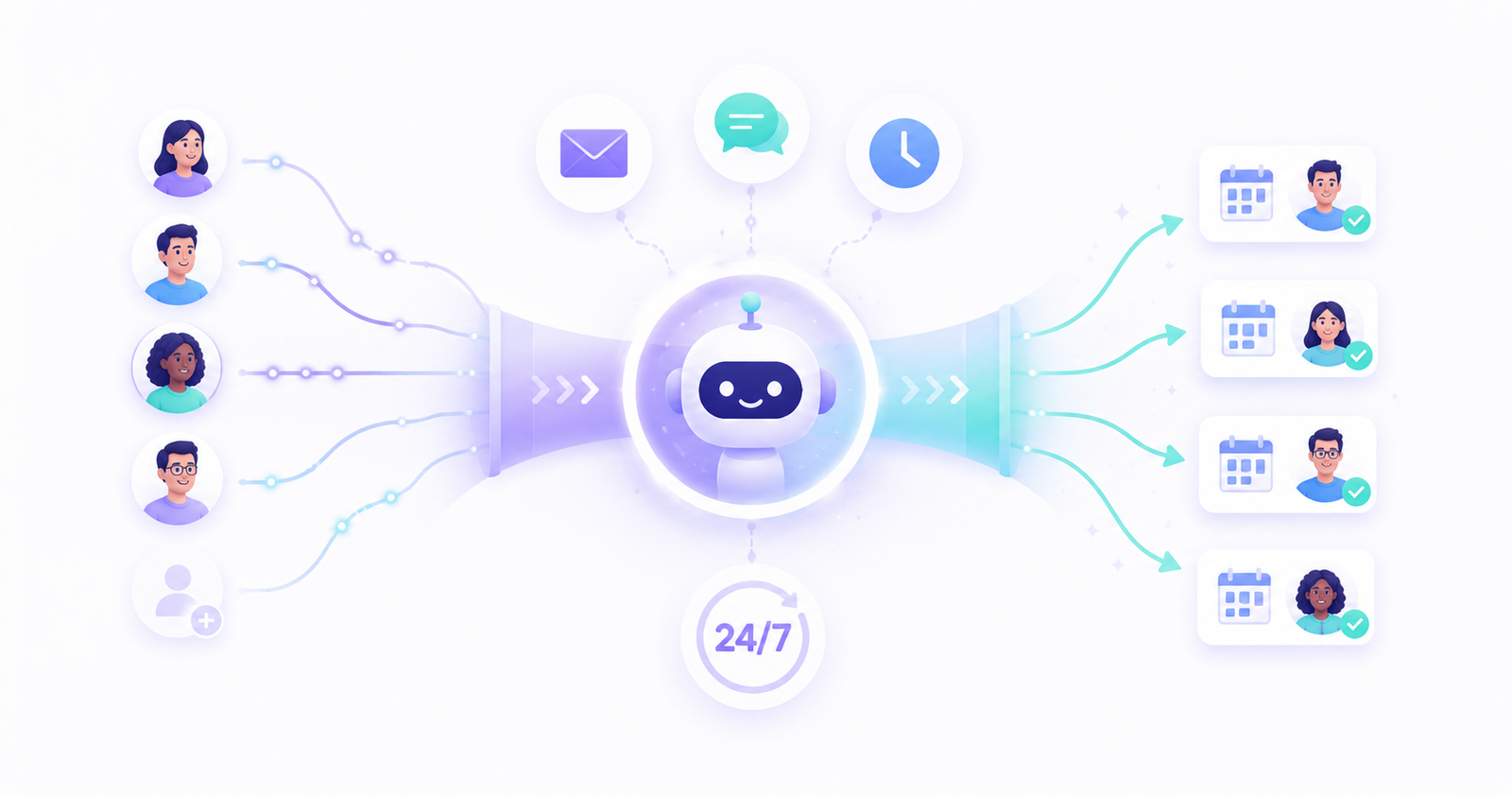
An AI sales agent is software that autonomously handles sales development work that used to require a human: finding prospects, reaching out, personalising messages, following up, qualifying interest, and booking meetings. It is sometimes called an AI SDR, an AI sales rep, or an autonomous sales agent. Whatever the label, the idea is the same: a tireless system that runs the repetitive, time-heavy top of your sales funnel on its own.
It is worth being precise here, because the term gets thrown around loosely. An AI sales agent is a specific, powerful form of AI automation aimed squarely at sales. It does not just send the same template to everyone like an old mail-merge tool. It reads, researches, decides, and adapts, which is what separates a genuine agent from a basic autoresponder.
Why AI Sales Agents Matter Now
To understand why these exploded in 2026, you have to see the problem they solve. Traditional sales development is broken in two expensive ways: speed and time.
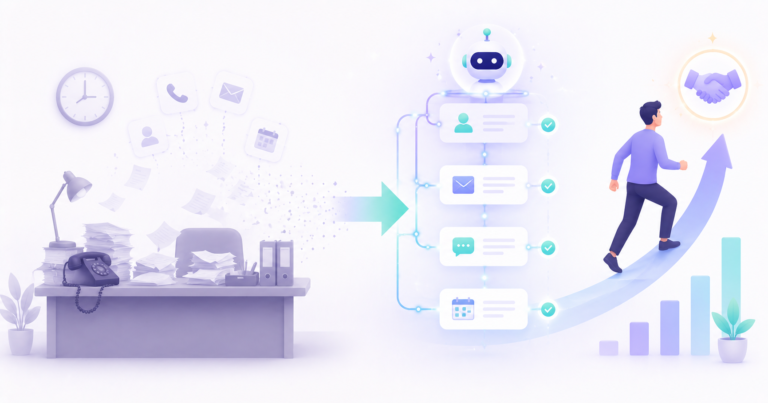
First, speed. A lead contacted within five minutes is around 21 times more likely to qualify than one contacted after thirty minutes, yet most businesses take hours or days to respond. Every minute a hot lead waits, it cools. Second, time. Research including Salesforce’s State of Sales consistently finds that a human sales rep spends under 36% of their time actually selling. The rest disappears into research, data entry, chasing replies, and admin. An AI sales agent attacks both problems directly: it responds instantly and it absorbs the busywork.
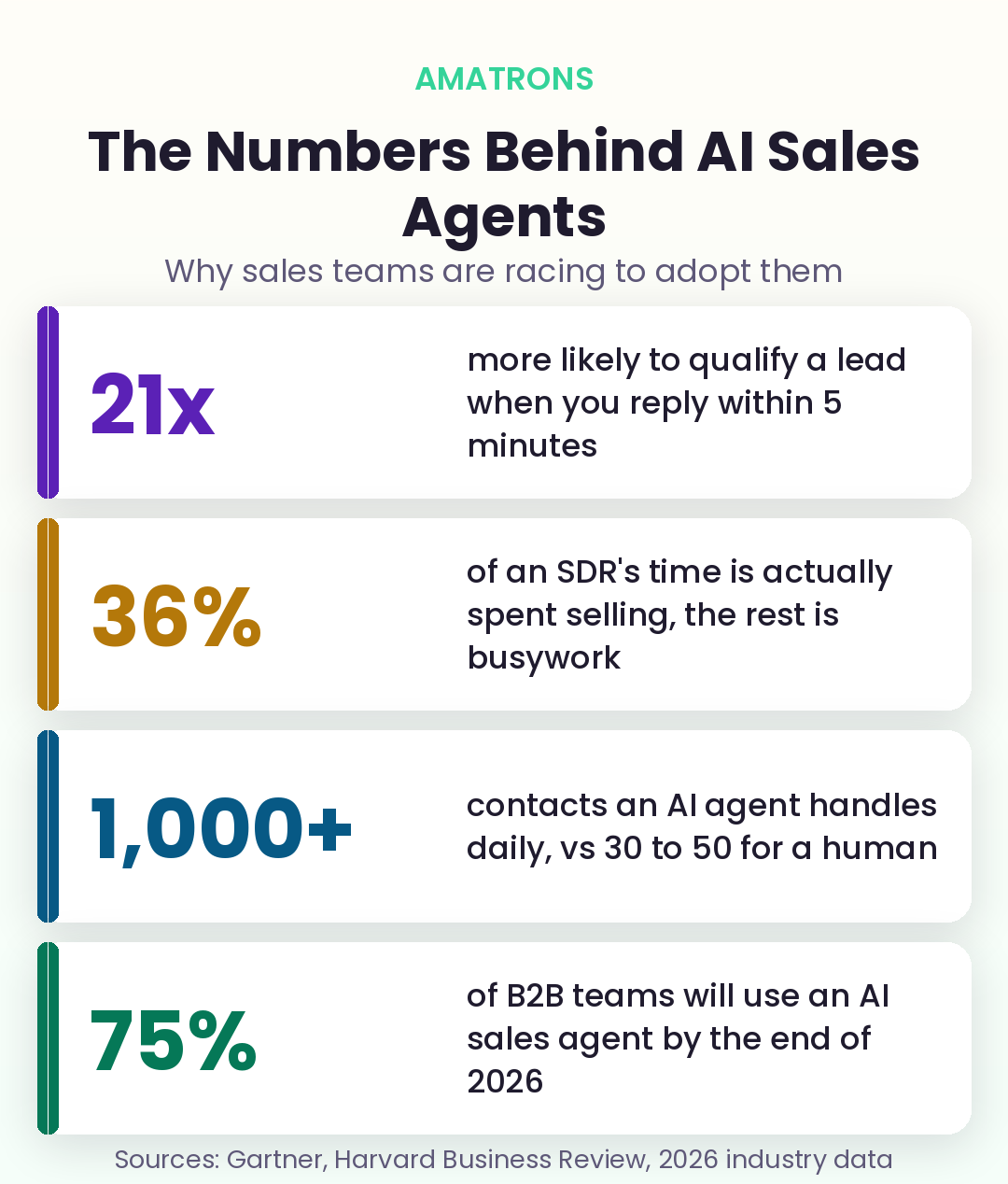
The market reflects it. The AI SDR market grew to around $5.8 billion in 2026 and is projected to more than triple by 2030, and roughly 75% of B2B teams are expected to use an AI sales agent by the end of 2026. This has moved from experiment to standard infrastructure in barely two years, part of the wider shift that McKinsey’s research tracks across nearly every business function.
How an AI Sales Agent Works
So what does it actually do, step by step? A good AI sales agent runs the same loop a skilled SDR would, just faster and without stopping.
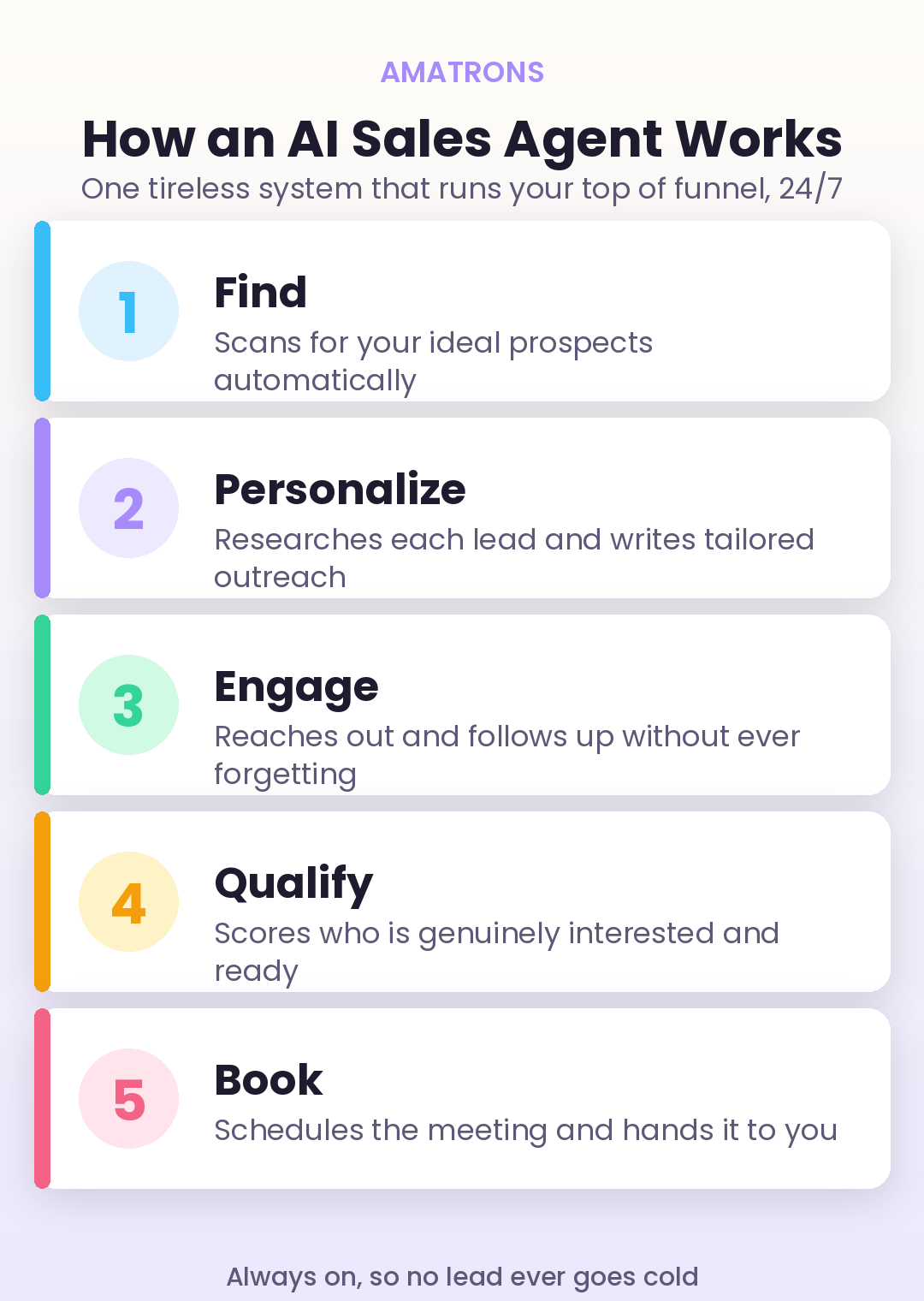
1. It Finds the Right Prospects
The agent scans for companies and people that match your ideal customer profile, using signals like job changes, hiring, funding, or technology use to spot who is likely in the market right now. No more guessing or buying stale lists.
2. It Personalises the Outreach
This is the part that separates a real agent from spam. It researches each prospect and writes a message tailored to them, referencing something real about their business. Research-based personalisation gets several times the reply rate of generic templates, which is exactly why AI is outperforming human-only outreach in 2026, and it is why quality matters far more than volume.
3. It Engages and Follows Up
The agent reaches out across email, and even on live phone calls through an AI voice agent, then does the thing humans hate most: it follows up, consistently, on schedule, without forgetting. Most sales are lost in the follow-up gap, and this is where the agent quietly wins back revenue.
4. It Qualifies the Interested
When prospects reply, the agent reads the response, gauges genuine interest and intent, and scores them. Only the warm, qualified ones move forward, so your human team never wastes time on dead ends.
5. It Books the Meeting and Hands Off
For a qualified, interested prospect, the agent schedules the meeting straight into your calendar and hands over a fully briefed lead. Your closer walks into the conversation with context already prepared, ready to do what humans do best.
AI Sales Agent vs a Human Sales Rep
Here is where most articles get it wrong, so let us be honest. An AI sales agent is not a straight replacement for a good human closer, and anyone selling it that way is overpromising.
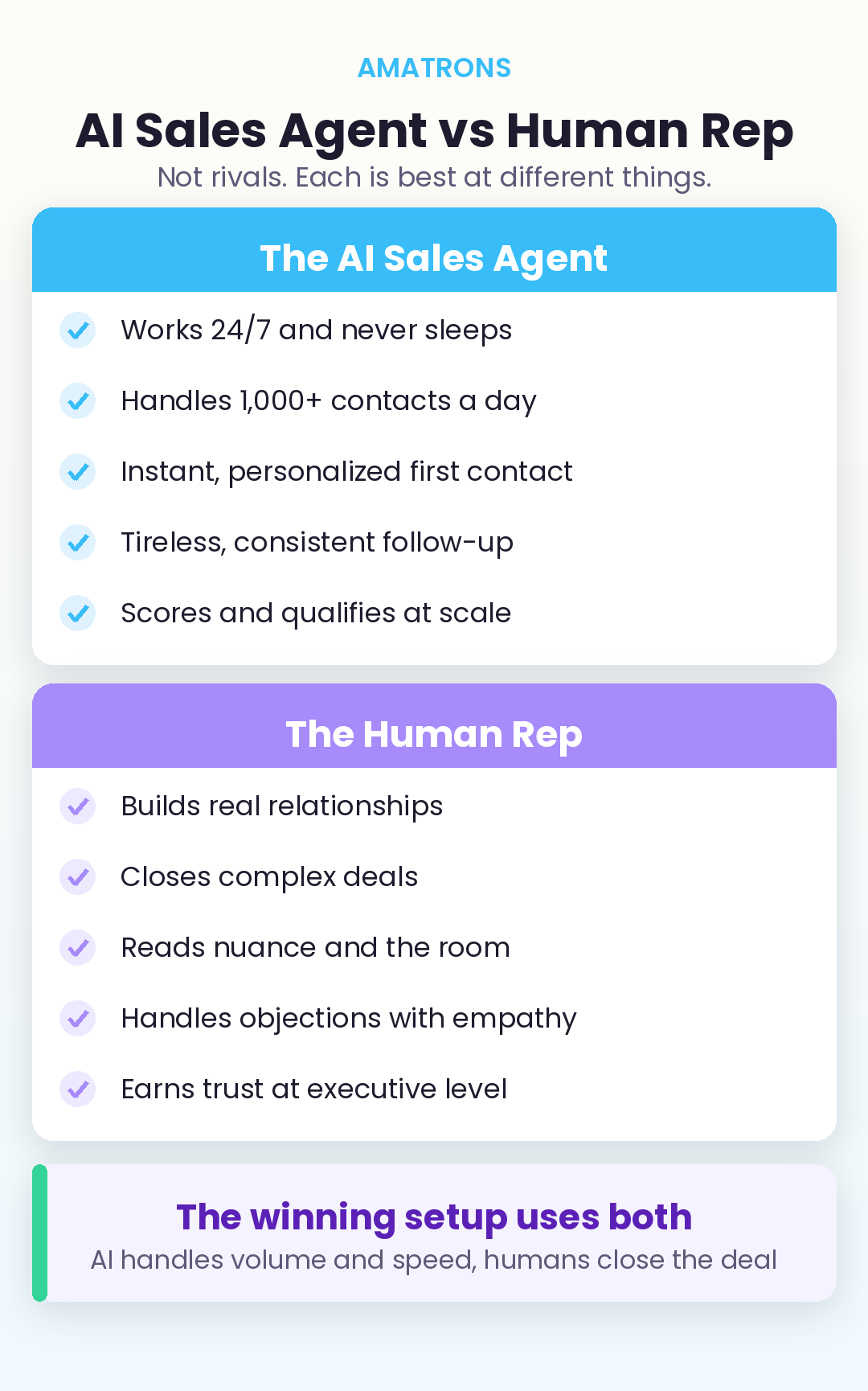
The data is clear and balanced. AI agents win decisively on speed, scale, and tireless follow-up, handling over a thousand contacts a day where a human manages thirty to fifty, which is why AI sales agents are increasingly replacing the traditional SDR role. But on the things that close complex deals, building real trust, reading nuance, handling a delicate objection, humans still win, and head-to-head studies show human reps convert qualified meetings into revenue at notably higher rates. The takeaway is not AI versus human. It is AI plus human. Teams running this hybrid model, with AI handling volume and speed while people handle the closing, report the strongest results of all. We go deeper on this in our guide to the ROI of AI automation.
What an AI Sales Agent Is Best At
To make the strengths concrete, here is where an AI sales agent delivers the most value, shown by how much of each job it can take off your plate.
The pattern is obvious. Point an AI sales agent at the repetitive, high-volume, speed-sensitive top of your funnel, and keep your humans on the relationship and the close. That division of labour is where the magic happens.
What It Costs and What You Get Back
Cost depends on whether you buy an off-the-shelf tool or have a custom agent built around your business. Either way, the economics are compelling because of what a human SDR costs by comparison.
The honest caveat is that an AI sales agent only pays off when it is set up well: a tight ideal customer profile, genuine research-based personalisation, and clean sender infrastructure so messages land instead of hitting spam. Done badly, it just sends fast junk. Done well, it becomes a revenue engine. This is the same lesson that runs through all good business automation: the technology is not the hard part, the setup is.
Who Should Use an AI Sales Agent?
This is not only for big sales teams. In fact the leverage is often greatest for small ones. Consider it seriously if you recognise any of these.
- You are a solo founder or tiny team. An AI sales agent gives you a full prospecting and follow-up operation without hiring an SDR you cannot yet afford. Coaches and consultants in particular can build a lean setup from the best AI sales tools for coaches and consultants.
- Leads slip through the cracks. If enquiries wait hours for a reply or follow-ups get forgotten, you are losing revenue an agent would capture.
- You want to grow pipeline without growing headcount. The agent scales outreach far beyond what your current team could manage by hand.
- Your reps are buried in busywork. If your salespeople spend more time prospecting than closing, an agent frees them to do what they are paid for.
AI Sales Agent vs AI SDR vs Chatbot: The Terms Explained
The labels around this technology get muddled, so here is a clear map. They are not all the same thing, and knowing the difference helps you buy the right tool.
- AI sales agent is the broad term for autonomous software that runs sales development tasks end to end, from finding prospects to booking meetings.
- AI SDR means the same thing in practice. SDR stands for sales development representative, the role focused on prospecting and qualifying, so an AI SDR is simply an AI sales agent framed by the job it replaces.
- AI salesperson or AI sales rep are looser consumer-friendly terms for the same category, though a true closer is still human.
- Chatbot is different. A chatbot is reactive and waits on your website to answer questions. A sales agent is proactive: it goes out, finds prospects, and runs campaigns. A chatbot answers; an agent hunts.
So when you see AI sales agent, AI SDR, or autonomous sales agent, you can treat them as the same tool. The important distinction is agent versus chatbot, because they solve very different problems and confusing them leads to buying the wrong thing.
Real Examples of AI Sales Agents in Action
The concept clicks fastest with concrete examples. Here is how different businesses put an AI sales agent to work.
A Solo Consultant
A one-person consultancy has no time to prospect while delivering client work. An AI sales agent quietly runs outreach in the background, books a handful of qualified discovery calls each week, and lets the consultant stay billable. It is the prospecting team they could never afford to hire.
A Small B2B Software Company
A four-person sales team adds an agent to handle the cold outreach they never had bandwidth for. The agent runs hundreds of personalised touches a day and routes only interested replies to the reps, who suddenly spend their time in real conversations instead of sending emails. Monthly meetings climb without a single new hire, much like the SaaS team in our AI sales agent case study that tripled qualified leads in 60 days.
A Local Service Business
An agency or service firm uses the agent to instantly answer and follow up with every inbound enquiry, day or night. The leads that used to go cold over a weekend now get a fast, personal first response, and more of them turn into booked calls.
Different businesses, one pattern: the agent takes the repetitive, speed-sensitive outreach and follow-up, and the humans do the closing. For a deeper look at how these time savings compound across a whole business, see our AI automation case study.
How to Get Started With an AI Sales Agent
If this sounds like something your business needs, here is the sensible way to begin without wasting money on a tool that ends up in the spam folder. For a full walkthrough, see our step by step guide on how to set up an AI sales agent in 7 days.
- Define your ideal customer precisely. The agent is only as good as its target. Get clear on exactly who you sell to before anything else, because a sharp profile is what makes the outreach relevant.
- Nail your message and offer. Decide what you are saying and why someone should care. The agent scales your message, so a weak one just fails faster and louder.
- Set up clean sending infrastructure. This unglamorous step decides whether your emails land or get marked as spam. It matters more than the tool itself, and skipping it is the top reason agents fail.
- Start small and measure. Run a focused campaign on one segment, watch reply and meeting rates, and refine the targeting and message before scaling up.
- Keep a human in the loop. Let the agent run volume and follow-up, but have your team review replies and handle the real conversations. That hybrid setup is what produces the best results.
If wiring all of that together is not how you want to spend your time, having it built and tuned for you is exactly what our AI sales agent service handles, from targeting to setup to the human handoff.
Mistakes That Make AI Sales Agents Fail
An AI sales agent is not magic, and plenty of businesses get poor results from one. Almost always, it traces back to one of these avoidable mistakes.
- Blasting generic templates. The fastest way to get ignored and land in spam. Without genuine, research-based personalisation, volume works against you.
- Ignoring sending infrastructure. Send too aggressively from an unprepared domain and your deliverability collapses. Many programs fail here within ninety days, purely on setup.
- Targeting everyone. A vague customer profile means irrelevant outreach. A tight, specific target is what makes the agent feel personal rather than spammy.
- Expecting it to close. Handing complex closing to the AI and skipping the human disappoints. Keep people on the part of the sale that needs them.
- Setting it and forgetting it. The first weeks need tuning of targeting and messaging based on real replies. Walk away too early and results drift.
Frequently Asked Questions
What is an AI sales agent in simple terms?
Is an AI sales agent the same as a chatbot?
Will an AI sales agent replace my sales team?
How much does an AI sales agent cost?
Do AI sales agents actually work, or do they just send spam?
The Bottom Line
So, what is an AI sales agent? It is the tireless, always-on engine for the top of your sales funnel, the part that finds prospects, reaches out instantly, follows up without fail, and books the meetings, so your human team can spend their time where they are irreplaceable: closing. Used as a replacement for people, it disappoints. Used as an amplifier for them, it is one of the highest-leverage tools a business can adopt in 2026. If your business is losing sales to slow replies, missed follow-ups, or simply not enough hours in the day, this is the gap worth closing. If you would like that engine built and tuned for your business, that is exactly what our AI sales agent service is built to do.