Every founder who looks at an AI sales agent asks the same question first. Not how it works. Not which platform is best. They ask whether it pays for itself, and how fast. That is the right question, and most articles dodge it with vague promises about efficiency and the future of work.
This guide does the opposite. It gives you the actual numbers, the timeline they land on, and the math you can run on your own pipeline before you spend a rupee or a dollar. By the end you will know what month one looks like, what changes by month three, and which metrics decide whether the investment was smart or wasteful.
Let me be honest about one thing up front. An AI sales agent is not magic. If your offer is weak or your lead source is dead, no software fixes that. But if you already get inbound interest and you are losing it to slow follow up and gaps in coverage, the return shows up quickly. That is the situation most coaches, consultants, and small B2B teams are actually in.
First, what does ROI on an AI sales agent really mean?
ROI here is simple. You take the new revenue and cost savings the agent creates, subtract everything it costs you to run, then divide by that cost. The trap is measuring only the obvious savings and ignoring the bigger lever, which is recovered pipeline. Most of the value is not in cutting a salary. It is in catching leads that used to slip away.
The reason this matters is that revenue people often try to prove value with a single number and fail. ROI on a sales agent lives across several metrics at once: how fast leads get a response, how many turn into meetings, how much pipeline gets created, and how the cost per qualified meeting moves. If you are still fuzzy on what one of these systems actually does day to day, our pillar guide on what an AI sales agent is breaks down the mechanics before you weigh the returns. The good news is that the early signals appear fast enough to defend the spend within weeks rather than quarters.
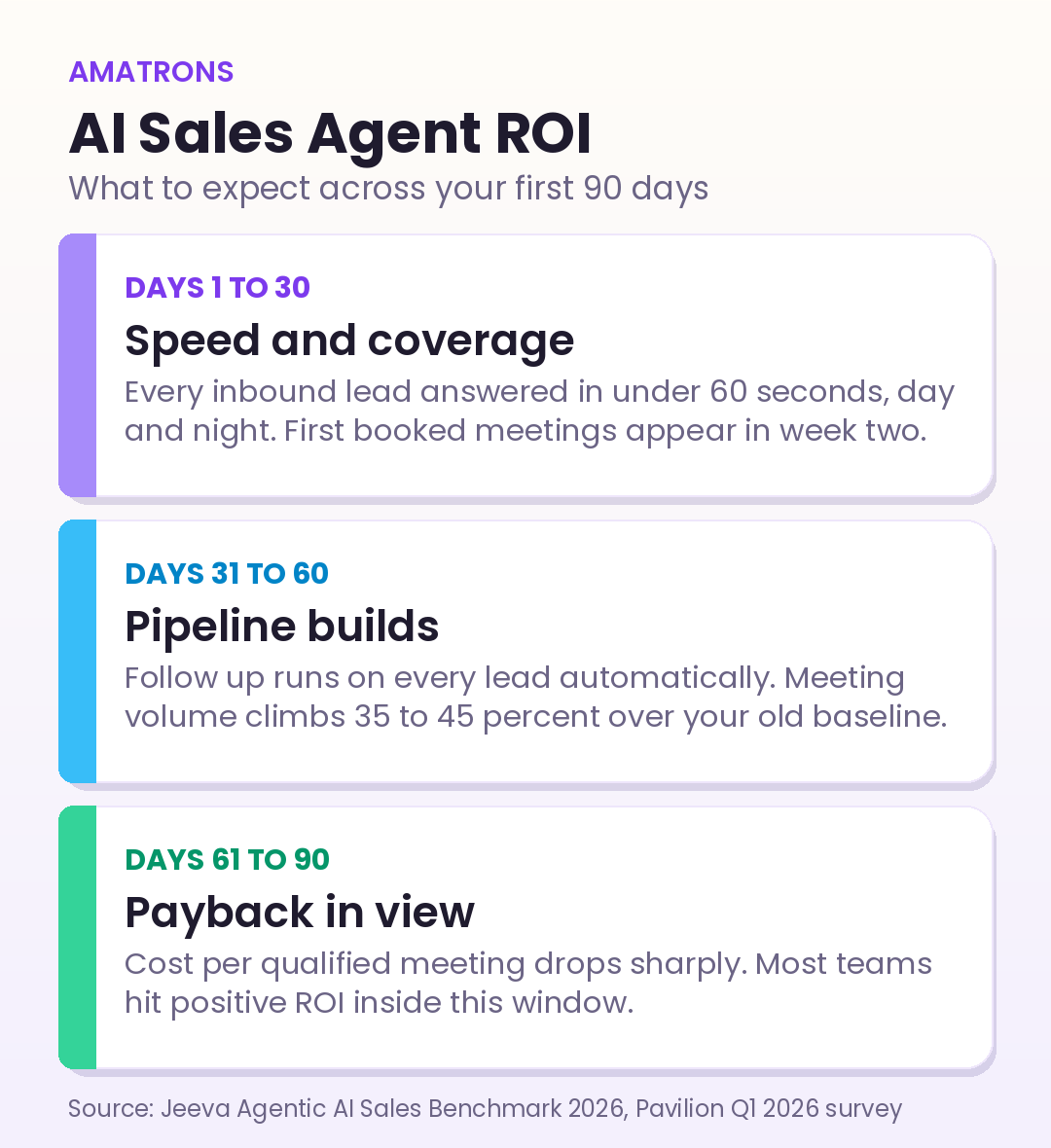
Days 1 to 30: speed and coverage do the heavy lifting
The first month is not about closing more deals. It is about stopping the leak. The single biggest reason businesses lose inbound leads is slow response, and the data on this is brutal. A widely cited Harvard Business Review study that analyzed over 2.2 million leads found that firms responding within one hour were seven times more likely to qualify a lead than those that waited even sixty minutes longer, and sixty times more likely than those that waited a full day.
Now look at how most businesses actually perform. Multiple 2026 studies put the average B2B lead response time at around 42 hours. An AI sales agent collapses that to under a minute, every hour of every day. It does not eat lunch, it does not log off at 6pm, and it does not ignore the lead that arrives at 11pm on a Saturday. According to the 2026 Jeeva benchmark report, roughly 38 percent of high intent leads arrive outside standard business hours, and those are exactly the ones a human team responds to slowest.
So what shows up in month one? Three things. First, every lead gets an instant, relevant reply. Second, the calendar starts filling because the agent books meetings while you sleep. First booked meetings usually appear inside week two. Third, your team stops doing the low value chasing and starts spending time only on conversations worth having. You will not see a clean ROI number yet, but you will feel the difference in your calendar almost immediately.
Days 31 to 60: the pipeline starts compounding
By the second month, the agent has enough conversations behind it to show a pattern. The metric that moves most clearly here is meeting volume. A Pavilion member survey from the first quarter of 2026, covering 112 sales teams, found that AI augmentation lifted meeting volume by 35 to 45 percent over the previous baseline, mostly through better targeting and relentless follow up consistency.
That last phrase is the quiet hero of AI sales ROI. Most sales are lost not on the first touch but in the follow up that never happens. Human reps average barely more than one follow up attempt before giving up. An AI agent follows up on schedule, on every lead, without fatigue or forgetfulness. That alone recovers deals you were already paying to generate.
What to watch in month two
- Meetings booked per week. This should be trending clearly upward against your month zero baseline.
- Lead to meeting conversion. Faster response plus consistent follow up usually lifts this noticeably.
- Pipeline created. Add up the value of opportunities the agent sourced or qualified. This is your real revenue signal.
- Cost per qualified meeting. As volume rises against a fixed software cost, this number starts dropping fast.
This is also the month to resist a common mistake. Do not judge the agent on closed deals yet, because your sales cycle is probably longer than 60 days. Judge it on pipeline and meetings, which are the leading indicators that closed revenue follows. If those are up, the money is coming.
Days 61 to 90: payback comes into view
By month three you can finally run the full ROI math with real data instead of projections. This is where the cost comparison becomes impossible to ignore, so let me lay it out plainly.
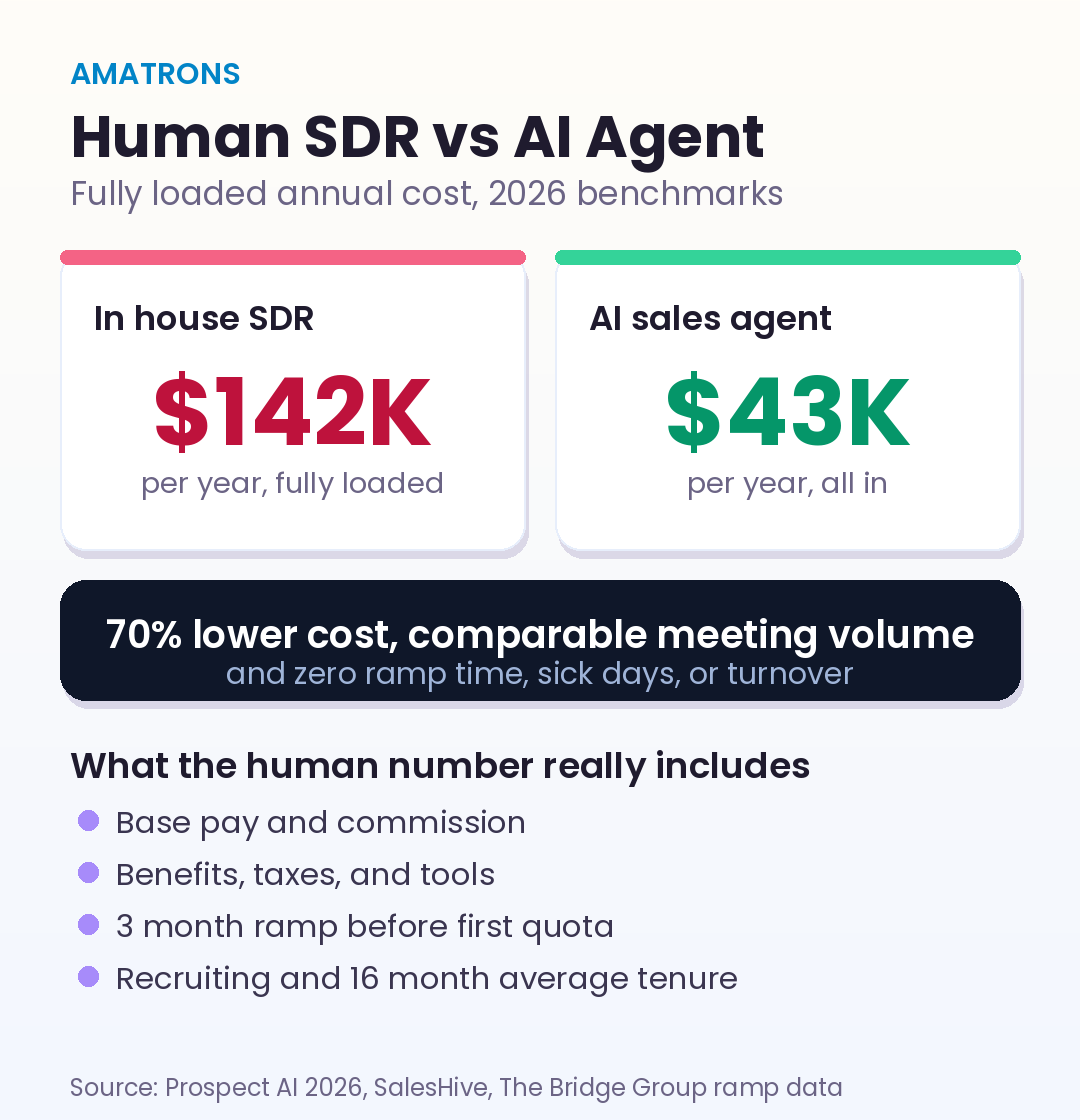
A human sales development rep does not cost their salary. The fully loaded figure, once you add benefits, taxes, tools, management time, recruiting, and turnover, lands far higher. A 2026 breakdown from Prospect AI puts a fully loaded human SDR at around $142,500 a year, while a comparable AI sales agent setup comes to roughly $42,600. That is about 70 percent cheaper for comparable or higher meeting volume. We go deeper into this human versus machine math in our breakdown of how AI sales agents are replacing traditional SDRs.
It gets worse for the human math when you factor in time. Bridge Group data shows the average SDR takes 3.2 months to ramp to full productivity, and average tenure is only around 14 to 16 months. So you pay full salary for a quarter before they produce, then replace them roughly every year. The AI agent is productive in days and never quits.
This is why the headline ROI numbers in the market are so high. Vendors and analysts in 2026 commonly report an average annual ROI near 317 percent on AI sales agents, with a typical payback period of about 5.2 months. For inbound focused use, the Jeeva 2026 benchmark notes ROI can manifest within 30 days because response time impact is so immediate and measurable. Treat the eye catching numbers as a ceiling, not a guarantee, and run your own math below.
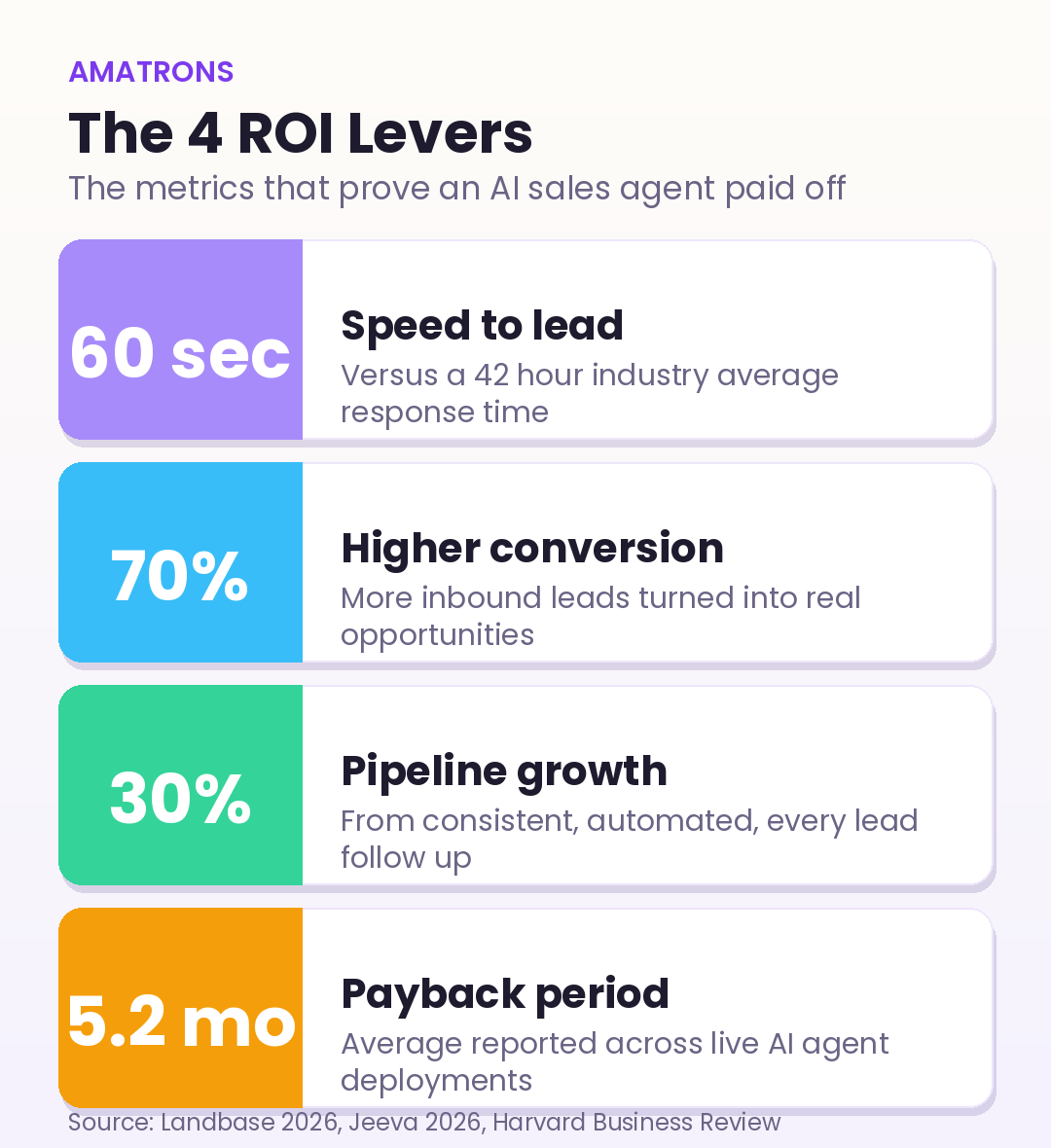
Run the math on your own numbers
Industry averages are useful for context, but your ROI depends on your inputs. Here is a simple way to estimate it before you commit. You only need four numbers from your own business.
- Monthly inbound leads. How many people raise their hand each month through forms, ads, DMs, or referrals.
- Current lead to meeting rate. What share of those leads you actually get on a call today.
- Average deal value. What one closed client is worth to you.
- Your close rate from meetings. How often a booked call turns into paying business.
Now apply a conservative lift. If an AI agent improves your lead to meeting rate by even 30 to 40 percent, which is below the reported averages, multiply that through to extra meetings, then to extra closed deals, then to extra revenue. Compare that monthly revenue gain to the agent cost. For most businesses with steady inbound, the extra revenue from a single recovered deal covers the monthly cost several times over.
The costs nobody mentions until later
Being your honest coach means flagging the parts vendors skip. ROI is real, but it is not free of effort. Budget for three things so your numbers hold up.
- Setup and tuning time. The first two to three weeks need your input to get the scripts, qualifying questions, and tone right. Garbage in, garbage out applies.
- Human oversight. Even a strong agent needs a few hours a week of review, especially early on, to catch edge cases and refine responses. The cost figures above already assume this.
- Clean lead flow. An agent amplifies whatever you feed it. If your traffic is junk, you will get fast, polite, well qualified rejections. Fix the top of the funnel in parallel.
None of these kill the ROI. They just mean the return is a result of a good setup, not an accident. The teams that see 90 day payback are the ones that treated the launch seriously, set a clean baseline before going live, and measured the deltas every week.
How to measure it so the result is defensible
If you want a number you can actually trust, do this before you flip the switch. Record your current speed to lead, lead to meeting rate, meetings per week, pipeline created, and cost per qualified meeting. These five become your baseline. Then measure the same five every week after launch. The gaps are your ROI, and because you took the baseline first, no one can argue the result was already happening. When you are ready to put one of these to work on your own pipeline, our AI sales agent service handles the build, the scripts, and the measurement setup for you.
The honest bottom line
An AI sales agent does not invent demand. What it does is make sure you never lose the demand you already have. In the first 30 days it stops the leak with instant response and full coverage. In days 31 to 60 it builds pipeline through follow up that humans simply do not sustain. By day 90 the cost math is clear, and for most businesses with real inbound flow, it has already paid for itself or is about to.
If you get steady leads and you are honest enough to admit some of them die in your inbox, the ROI question answers itself. The faster you set a baseline and go live, the faster the recovered revenue starts showing up in your numbers.