
AI for Small Business: A Complete Beginner’s Guide to Adoption, Tools, and Growth in 2025
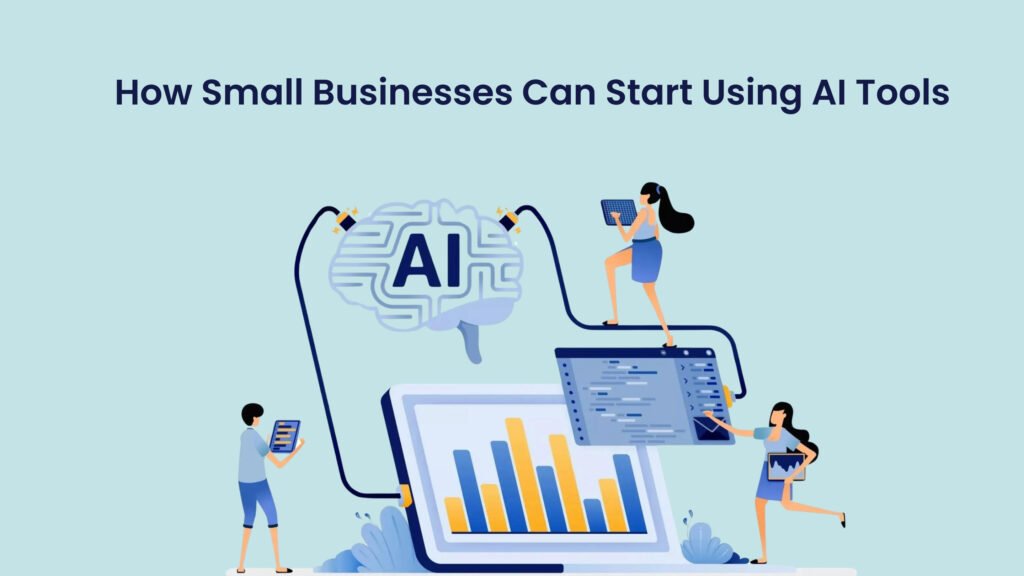
Introduction Why AI for Small Business Matters in 2025 Running a small business today is no easy feat. You’re juggling multiple roles—marketing, sales, operations, finance, all while trying to stay competitive in a rapidly evolving market. One of the biggest challenges is doing more with less: limited resources, tight budgets, and teams that are stretched thin. This is where AI for small businesses can be a game-changer. AI is no longer just a tool for tech giants. Startups and small businesses can now leverage AI tools to automate repetitive tasks, gain insights from data, and make smarter decisions faster. From chatbots handling customer inquiries to analytics tools predicting sales trends, AI adoption can save time, reduce costs, and even help you increase revenue. Consider this: according to a 2025 SMB AI adoption report, over 45% of small businesses that implemented AI tools reported a measurable increase in productivity within six months, and 38% saw higher revenue growth compared to competitors who hadn’t adopted AI. These aren’t just numbers, they are proof that using AI for business is no longer optional; it’s strategic. But here’s the thing: getting started can feel overwhelming. With so many AI tools for startups available, deciding where to begin is often the hardest part. That’s why this AI beginner business guide exists. It’s designed to walk you through practical steps for identifying opportunities, choosing the right tools, and implementing AI in a way that aligns with your business goals. By the end of this blog, you’ll not only understand why AI matters but also have a clear roadmap for how your small business can start using AI tools effectively. Whether you want to improve customer engagement, optimize operations, or make smarter data-driven decisions, these AI adoption tips will give you a structured path to success. Understanding AI and Its Relevance to Small Businesses Before diving into AI tools for startups, it is important to understand what AI really is and why it matters for small businesses. Many decision-makers assume AI is only for large corporations or requires a huge budget. That is no longer true. Small businesses can harness AI to solve real problems, improve efficiency, and gain a competitive edge. What AI Really Means for Small Business Artificial Intelligence refers to computer systems that can perform tasks that normally require human intelligence. These tasks include recognizing patterns, understanding language, making predictions, and learning from data over time. For small businesses, AI is not about replacing employees. It is about enhancing their capabilities and automating repetitive processes. Here are some practical examples of AI in small businesses: Customer Service: AI chatbots can handle frequently asked questions, freeing up your team for more complex queries. Marketing and Sales: AI can analyze customer behavior and suggest targeted campaigns to improve engagement and conversions. Operations: Inventory forecasting tools powered by AI help avoid stockouts or overstock situations. Finance: AI tools can automate invoice processing and detect anomalies to reduce errors. These are not futuristic scenarios. They are tools that small businesses are already using today to save time, reduce costs, and make smarter decisions. Common Myths About AI for Small Business Adoption Misunderstandings about AI often prevent small businesses from starting. Here are the three biggest myths and why they are not true: AI is too expensive: Many AI tools for startups are affordable and even subscription-based. You can start small and scale gradually. AI is only for tech-savvy businesses: Modern AI tools are designed to be user-friendly. Most require minimal technical knowledge. AI replaces humans: In reality, AI supports your team, enabling them to focus on higher-value tasks instead of repetitive work. Benefits of Using AI for Business The advantages of integrating AI into your small business are tangible. AI helps businesses streamline operations, increase revenue, and make informed decisions based on data. Here is a breakdown of key benefits with examples that can be easily tracked: Business Function AI Tool Example Potential Benefit Hypothetical Result (First 6 Months) Customer Service Chatbots, Virtual Assistants Faster response time, 24/7 support 30% increase in customer satisfaction Marketing and Sales Predictive Analytics, CRM AI Improved targeting, personalized campaigns 25% boost in lead conversion Operations Inventory Forecasting AI Reduce stockouts, optimize procurement 20% reduction in excess inventory Finance Automated Invoice Processing Reduce errors, save time 15 hours saved per month per employee Analytics and Reporting Business Intelligence AI Better data-driven decisions 10% faster decision-making These data points are realistic for small businesses just starting with AI adoption. You can represent this table in Excel to track improvements as you implement AI tools in different areas of your business. Why AI Matters Now Using AI for small business is no longer a future concept. Businesses that adopt AI today are better positioned to compete, respond to market changes, and deliver superior customer experiences. For decision-makers, understanding AI is not just about technology—it is about strategy. This AI beginner business guide is aimed at helping you identify practical applications that deliver measurable results without overwhelming your team or budget. Identifying AI Opportunities in Small Businesses Knowing that AI can help your business is one thing. Knowing where to start is another. Not every process in your business needs AI. The key is to identify areas where AI can solve real problems, save time, and deliver measurable results. This step is crucial for small businesses and startups with limited resources. Assessing Your Current Business Processes Start by analyzing your existing workflows. Look for tasks that are repetitive, time-consuming, or prone to errors. These are the areas where AI can provide the most immediate impact. Typical business functions where AI adds value include: Marketing: Lead scoring, campaign personalization, email automation. Sales: Predicting high-value prospects, automating follow-ups. Customer Support: Chatbots, automated ticket routing, FAQs. Operations: Inventory forecasting, supply chain optimization, scheduling. Finance: Invoice processing, expense tracking, fraud detection. For example, a small retail store may struggle with inventory management. Overstocking ties up cash, while stockouts frustrate customers. Implementing an AI-powered inventory forecasting tool can analyze past
AI in Business: 10 Real-World Examples Transforming Companies in 2025
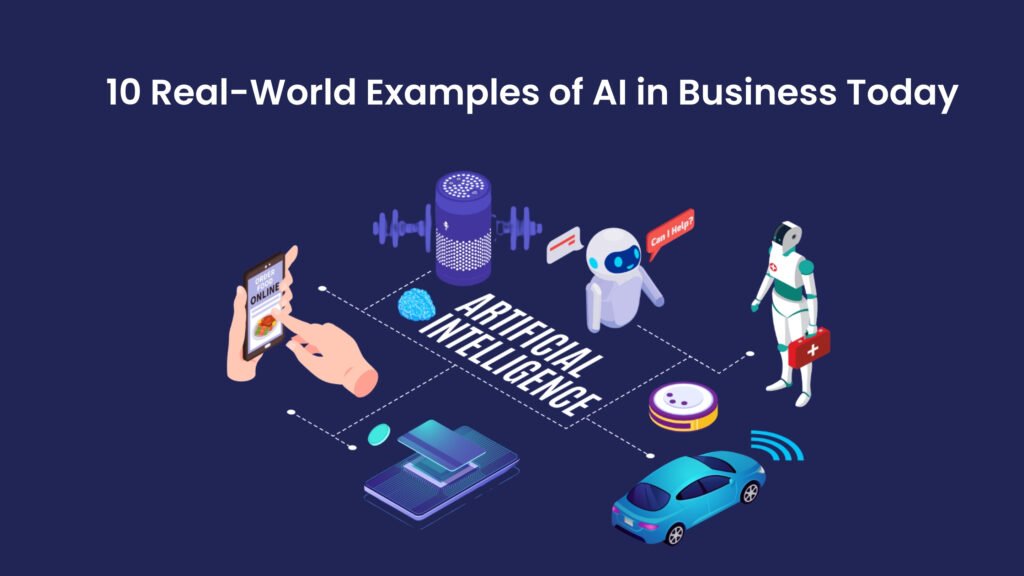
1. Introduction to AI in Business Artificial Intelligence is no longer something you only read about in science fiction. It has quietly moved into the heart of modern business, transforming how companies operate, make decisions, and serve customers. What once sounded like a distant future is now happening in real boardrooms, shop floors, hospitals, and customer service centers. When we talk about AI in business, we are not talking about experiments hidden inside research labs. We are talking about systems that millions of people interact with every day without even realizing it. Every time Netflix suggests a show you end up binge-watching, or your bank flags a suspicious transaction before you notice it, you are seeing AI at work. What makes this shift so powerful is not just the technology itself but the scale at which it is being applied. Businesses across industries have moved beyond pilot projects into full-scale adoption. They are using AI to cut costs, predict trends, discover insights, and create customer experiences that feel almost personalized to the individual. This article explores 10 real-world AI examples that are not just impressive demonstrations but practical case studies of companies already reaping measurable results. From retail giants fine-tuning your shopping cart to healthcare providers improving diagnoses, these AI use cases in 2025 show us how far we have come. By the end, you will see why AI is not a buzzword anymore but a foundational part of how businesses grow, compete, and survive. 2. AI in Business for Retail and E-commerce: Personalization at Scale Retail has always been about understanding what people want and delivering it better than anyone else. The problem is, in a world of millions of customers and billions of products, that kind of precision is impossible for humans alone. This is where AI has completely reshaped the game. Amazon and the Recommendation Engine Amazon is one of the most famous examples of AI in business. Its recommendation engine doesn’t just suggest products randomly. It studies your browsing history, purchase behavior, items you’ve clicked but not bought, and even what other people with similar habits purchased. This is why, after buying a phone, you instantly see cases, chargers, and screen protectors popping up in your feed. Amazon has reported that its recommendation system drives over 35% of its sales. That is not just a side feature. It is a core driver of revenue. Walmart and Supply Chain Optimization On the other end of retail, Walmart uses AI to manage one of the most complex supply chains in the world. Imagine millions of products moving across thousands of stores and warehouses. Even a tiny inefficiency at that scale means millions in losses. Walmart’s AI predicts demand more accurately, adjusts inventory in real time, and helps reduce waste. For instance, AI tools analyze weather data and social media chatter to anticipate spikes in sales. If there is a storm coming, Walmart’s system ensures shelves are stocked with essentials like flashlights and bottled water ahead of time. Personalized Shopping Experiences Another real-world AI example comes from companies like Sephora. Their AI-powered app allows customers to try makeup virtually using augmented reality and computer vision. Instead of guessing how a lipstick shade might look, shoppers can see it on their own face before buying. This doesn’t just improve customer experience; it reduces return rates and boosts confidence in online purchases. Why It Matters What these AI case studies show us is that retail is no longer about selling to the masses. It’s about tailoring every single experience. In 2025, companies using AI in retail are not only surviving but leading the industry. AI helps them understand demand, manage inventory, and make shopping more personal than ever. 3. AI in Business for Healthcare: Smarter Decisions, Better Patient Outcomes Few industries have more at stake than healthcare. A single decision can change or save a life, and the sheer amount of data doctors and hospitals deal with is overwhelming. AI has stepped in as a partner, not a replacement, helping healthcare providers make faster and more accurate choices. IBM Watson Health and Mayo Clinic IBM Watson Health was one of the first large-scale attempts to bring AI into real-world medicine. At the Mayo Clinic, Watson was used to match cancer patients with the most suitable clinical trials. Normally, this process takes doctors weeks of cross-checking records and trial requirements. Watson could analyze patient data and clinical trial information in minutes, giving doctors a shortlist of matches. While Watson had its limitations, it sparked a movement where AI became a core tool in clinical research and patient care. DeepMind and the NHS In the UK, Google’s DeepMind partnered with the National Health Service to tackle a problem that affects thousands of patients: kidney disease. Their AI model could predict acute kidney injury up to 48 hours before it became life-threatening. Doctors received alerts early enough to intervene, preventing complications and saving lives. This is a clear real-world AI example where algorithms literally made the difference between life and death. AI in Diagnostics AI is also transforming diagnostics. PathAI, for example, uses machine learning to assist pathologists in analyzing tissue samples. Studies show that AI systems can identify certain cancers with equal or better accuracy than human specialists. Radiology has also seen a breakthrough. AI tools help scan X-rays and MRIs, flagging anomalies faster than traditional processes. Instead of waiting days, patients can sometimes get results in hours. Predictive Analytics and Preventive Care Hospitals like Mount Sinai in New York have deployed AI systems that track patient data in real time. By analyzing heart rate, blood pressure, and lab results, AI predicts who might develop sepsis or other critical conditions before symptoms become obvious. Early action means fewer complications and better patient outcomes. Why It Matters These AI case studies prove that healthcare is not just about treating illness anymore. It is about predicting and preventing problems before they happen. In 2025, companies using AI in healthcare are setting a new standard