Here is the uncomfortable truth most leadership teams avoid. A slow or poorly optimized website is quietly draining revenue every single day. Not because the product is weak or the marketing budget is low. It happens because users do not wait. They judge. They leave. And they rarely come back.
For US businesses competing in crowded digital markets, website performance is no longer a backend concern. It is a frontline business issue. Speed delays create friction. Poor user experience signals lack of credibility. Inconsistent performance erodes trust long before a sales conversation even begins. What this really means is that your website may be losing deals before your team ever gets a chance to engage.
Decision makers often invest heavily in branding campaigns paid media and new features while assuming the website can handle it. In reality performance bottlenecks turn those investments into sunk costs. Traffic arrives with intent but leaves with frustration. Conversions drop not because demand is low but because experience is broken.
Website performance optimization tips matter because performance is not about milliseconds. It is about momentum. A fast stable and predictable website builds confidence. It keeps users engaged. It supports SEO. It improves conversion efficiency. Most importantly it aligns digital execution with business ambition.
This is where performance optimization shifts from being a technical checklist to a growth lever. When leaders understand performance through the lens of revenue trust and long term scalability it becomes clear that optimizing a website is not maintenance work. It is a strategic decision that directly impacts how the business grows.
Why Website Performance Is a Business Problem Not a Technical Detail
Leadership teams often see website performance as something the tech team will handle eventually. The data tells a very different story. Performance issues show up directly in revenue leakage trust erosion and visibility loss. Below is a clear view of how slow performance translates into business damage using realistic and widely accepted industry benchmarks.
Why leadership teams still underestimate performance
| Performance Factor | What Leaders Often Assume | What Actually Happens in Reality |
|---|---|---|
| Page load delay of 1 second | Users will wait | Conversion rates drop by around 7% |
| Page load over 3 seconds | Minor inconvenience | Over 50% of users abandon the page |
| Performance reports in technical tools | No urgent action needed | Revenue impact remains invisible to leadership |
| Heavy marketing spend | Traffic guarantees growth | Traffic exits before engaging or converting |
| Performance owned only by developers | Not a leadership concern | Business KPIs quietly decline |
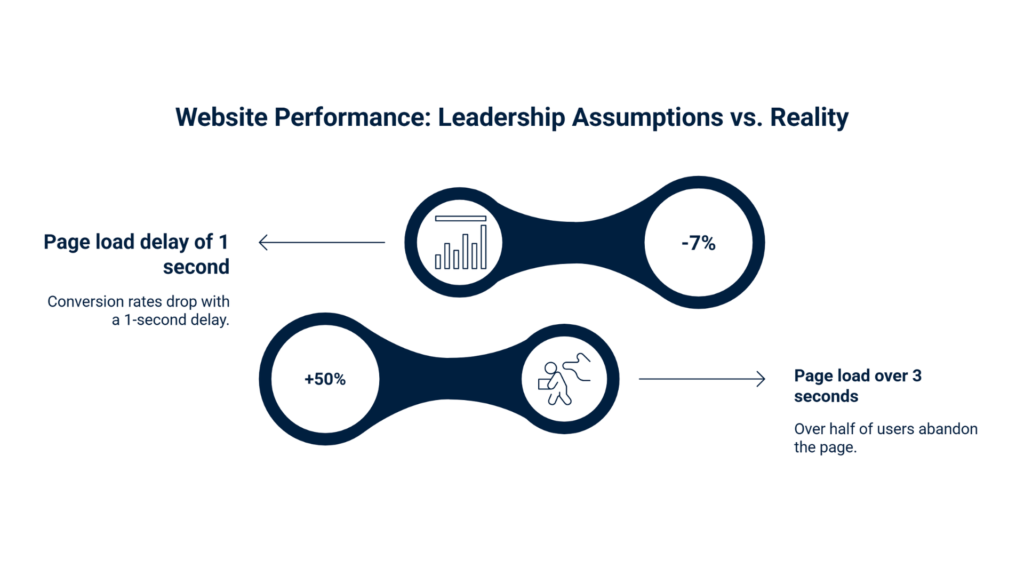
What this shows is simple. When performance is measured only in technical scores and not tied to revenue or conversion data it stays under the radar. Leaders focus on growth initiatives while the foundation quietly weakens.
The hidden cost of slow websites on revenue trust and SEO
| Business Area Affected | Realistic Industry Data | Direct Business Impact |
|---|---|---|
| Revenue per visitor | Around 4% revenue loss with a 2 second delay | Hundreds of thousands of dollars annually for mid size sites |
| Conversion rate | Up to 7% drop per extra second | Fewer leads fewer sales lower ROI |
| User trust perception | Slow sites seen as less reliable | Lower brand credibility and repeat visits |
| Bounce rate | Over 50% abandonment after 3 seconds | Paid and organic traffic wasted |
| SEO visibility | Speed is a confirmed ranking factor | Reduced organic traffic and higher acquisition cost |
| Paid media efficiency | Slow landing pages increase CPA | Higher ad spend for the same results |
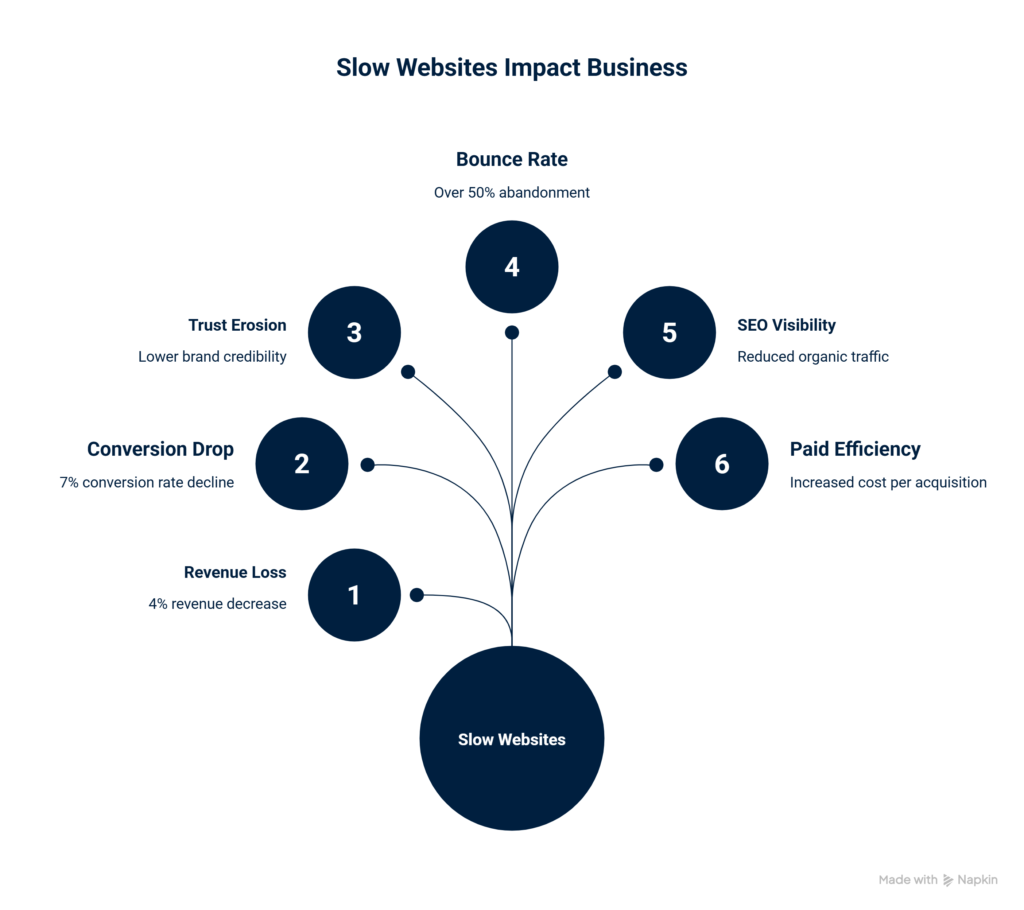
For US businesses operating in competitive digital markets this compounds fast. A site generating one million dollars annually can easily lose tens of thousands of dollars simply due to performance delays that feel minor on the surface.
What really matters here is not the numbers alone. It is the pattern. Slow websites leak revenue before a sales conversation begins. They damage trust before a brand message is absorbed. They weaken SEO before competitors even need to outspend you.
This is why website performance must be owned at the leadership level. Not as a technical cleanup task but as a core business decision tied directly to growth efficiency and long term market position.
Speed Is the First Impression Your Business Makes
Speed is not a background metric. It is the first experience your customer has with your brand. Before they read a headline trust a claim or evaluate an offer they feel speed. That feeling shapes behavior instantly and often permanently.
How load speed shapes user perception and behavior
| Load Experience | User Reaction | Business Outcome |
|---|---|---|
| Page loads under 2 seconds | Feels reliable and professional | Higher engagement and deeper sessions |
| Page loads between 2 and 3 seconds | Tolerated but noticed | Drop in interaction and focus |
| Page loads over 3 seconds | Feels slow and frustrating | Sharp increase in bounce rates |
| Delays during clicks or scroll | Loss of confidence | Abandoned forms and carts |
| Inconsistent speed across pages | Brand feels unstable | Reduced trust and repeat visits |
Research consistently shows that users subconsciously associate speed with competence. A fast website feels modern and trustworthy. A slow one feels risky. This judgment happens before logic kicks in. Once that perception is formed it is very hard to reverse within the same session.
Common speed issues in growing US businesses
| Speed Issue | Why It Happens | Business Impact |
|---|---|---|
| Heavy images and media | Design focused updates without optimization | Slower load times and visual delays |
| Too many third party scripts | Marketing and analytics added over time | Page blocking and delayed interaction |
| Weak hosting infrastructure | Outgrown initial hosting plans | Inconsistent speed during traffic spikes |
| No caching strategy | Reliance on dynamic page loads | Repeat visitors still experience delays |
| Platform and plugin overload | Feature driven growth | Accumulating performance debt |
Speed benchmarks that actually impact conversions
| Performance Metric | Benchmark That Matters | Why It Matters |
|---|---|---|
| Time to first interaction | Under 2 seconds | Users feel in control quickly |
| Full page usability | Under 3 seconds | Prevents early abandonment |
| Interaction delay | Under 100 milliseconds | Clicks feel instant and responsive |
| Speed consistency | Stable across pages | Builds confidence and flow |
| Mobile performance | Equal or better than desktop | Majority of traffic originates on mobile |
What matters here is not chasing perfect scores. It is hitting thresholds where users stop noticing friction. Every second shaved off load time increases the likelihood that users stay engage and convert.
For decision makers this reframes speed entirely. Speed is not an engineering vanity metric. It is the first sales conversation your website has with every visitor. If that conversation feels slow distracted or unreliable most users will never give you a second chance.
User Experience Performance Where Most Conversions Are Lost
Many businesses assume that once a website is fast the job is done. That assumption is costly. Speed gets users through the door. User experience performance decides whether they stay engage and convert. This is where most revenue leaks happen quietly and consistently.
Why fast websites still fail on user experience
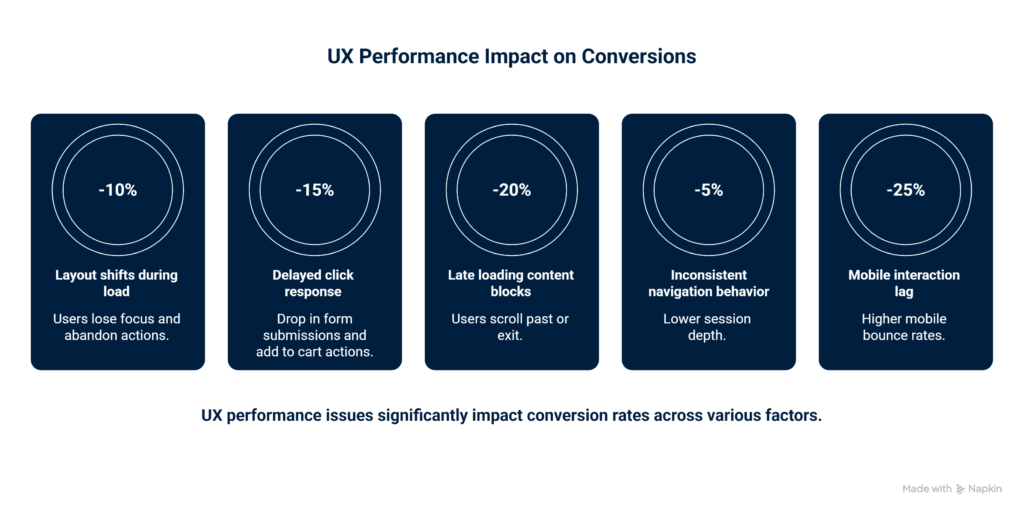
One of the most common reasons is visual instability. When elements move while a page loads users lose their place. Buttons shift. Headlines jump. Forms move just as someone is about to interact. This creates frustration and doubt even if the page technically loaded quickly.
Another issue is delayed interaction. Users click but nothing seems to happen for a moment. That short pause signals unreliability. People start to question whether the site is working or whether their action registered. Many leave instead of waiting.
Content timing also plays a role. When key information or calls to action load late users often scroll past them. The opportunity to guide attention is lost. Navigation inconsistency across pages further compounds the problem. If each page behaves slightly differently users must re learn how to move through the site. That cognitive load reduces engagement.
On mobile these problems are amplified. Touch interactions that lag or feel unresponsive immediately push users away. Mobile users have less patience and more alternatives.
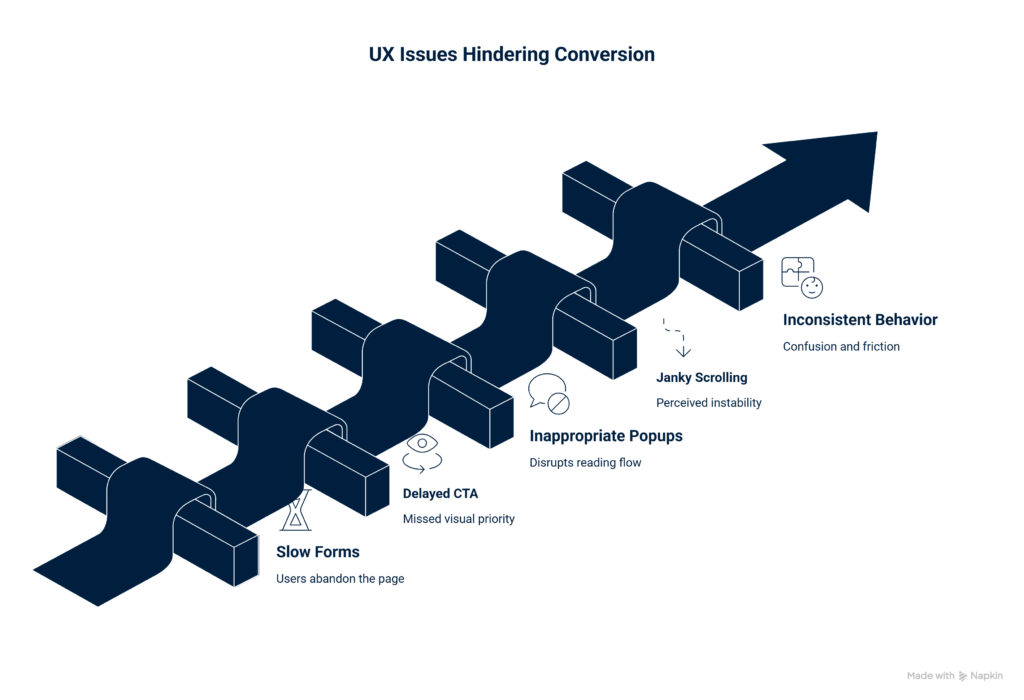
UX performance issues that quietly kill leads and sales
Most conversion killing UX issues do not trigger alarms. They show up in subtle behavior changes. Users start but do not finish forms. They view pricing but do not proceed. They scroll but never click.
Forms that load after the rest of the page often lose users before interaction begins. Calls to action that appear too late or shift position lose visual priority. Popups that interrupt reading flow break trust rather than build interest.
Scrolling that feels jumpy or animations that stutter create a sense of instability. Even if the brand is strong the experience feels unreliable. When behavior differs across devices users lose confidence that the site will work when it matters.
For decision makers this is a critical insight. Conversion drops are often blamed on traffic quality or messaging when the real issue is experience performance. The website feels uncertain at the moment users are deciding.
User experience performance is where speed meets psychology. When interaction feels smooth predictable and controlled users move forward. When it feels unstable they leave without explanation. Fixing this layer often unlocks growth faster than increasing traffic or spend.
Core Web Vitals Explained for Decision Makers
Core Web Vitals often get discussed in technical meetings and SEO reports but rarely in boardrooms. That disconnect is a problem. These metrics directly reflect how real users experience your website and how search engines judge its quality. When leaders understand Core Web Vitals in business terms they become far more than a compliance checklist.
What Core Web Vitals mean in business terms
At their core Core Web Vitals answer three simple questions every business should care about. How fast does your website feel when someone lands on it. How quickly can they interact with it. How stable does it feel while they are engaging.
If the first meaningful content appears late users feel ignored. If buttons and forms are slow to respond users feel uncertain. If the layout shifts while reading or clicking users feel frustrated. None of this feels technical to the visitor. It feels like poor service.
From a business perspective Core Web Vitals measure confidence. They indicate whether users feel in control or hesitant. A website that performs well on these signals creates a sense of reliability. A website that fails them creates doubt even if the product and messaging are strong.
This is why Core Web Vitals should be viewed as experience health indicators. They show whether your digital presence supports trust and decision making or quietly works against it.
How Core Web Vitals influence SEO and paid traffic ROI
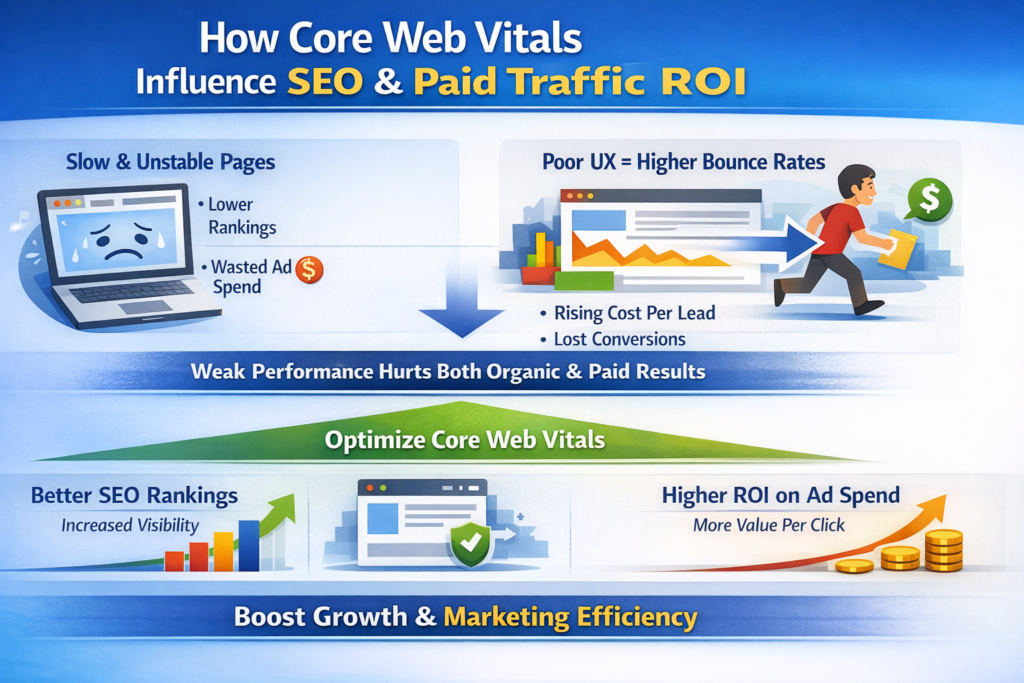
Search engines now treat user experience as a quality signal. Core Web Vitals are part of how Google evaluates which pages deserve visibility. When performance is weak rankings suffer especially in competitive US markets where many sites offer similar content and pricing.
What often gets overlooked is the impact on paid traffic. Slow and unstable pages reduce landing page effectiveness. Visitors from paid campaigns cost money to acquire but they abandon faster when performance is poor. This drives up cost per lead and cost per acquisition without any change in ad strategy.
Even small improvements in interaction speed and visual stability can improve engagement rates and conversion efficiency. That means more value extracted from the same traffic spend. Over time this compounds into a meaningful advantage.
For decision makers the takeaway is clear. Core Web Vitals are not an SEO technicality. They influence how efficiently your marketing dollars work and how visible your brand remains. Ignoring them weakens both organic growth and paid performance at the same time.
When leaders treat Core Web Vitals as a business experience signal rather than a technical scorecard they gain a clearer lever for improving growth efficiency and digital credibility.
Technical Foundations That Decide Long Term Performance
Website performance is shaped long before users experience it. It is determined by architectural and infrastructure decisions that either support growth or slowly restrict it. When these foundations are weak performance problems keep returning no matter how many surface level fixes are applied.
How poor architecture creates ongoing performance debt
• Short term feature driven decisions stack up over time without cleanup
• Multiple frameworks and plugins increase page weight and dependency risk
• Over customization makes even small changes slow and unpredictable
• Performance tuning becomes risky because systems are tightly coupled
• Each new update adds load instead of improving efficiency
• Teams spend more time fixing issues than improving experience
• Traffic growth exposes weaknesses that were hidden at low scale
What starts as convenience eventually turns into performance debt that compounds with every release.
Infrastructure and platform decisions that slow growth
• Hosting plans that were never upgraded as traffic increased
• Lack of proper caching leads to repeated server processing
• No content delivery strategy causes slow load times across regions
• Excessive third party tools block page rendering
• Platform upgrades focused on features rather than performance impact
• Design updates that add weight without improving usability
• Systems that struggle during campaigns traffic spikes or launches
For decision makers the message is clear. Technical foundations are not just engineering choices. They directly influence how fast the business can scale how reliable the website feels and how efficiently growth investments perform.
Strong foundations create flexibility speed and resilience. Weak foundations turn performance optimization into a recurring problem instead of a solved one.
Website Performance Optimization Tips That Drive Real Outcomes
Performance optimization only matters when it changes business outcomes. Many teams chase scores reports and tools without asking a more important question. Does this improvement help users move closer to a decision. When optimization is tied to revenue behavior it becomes far more focused and effective.
How to prioritize performance improvements that impact revenue
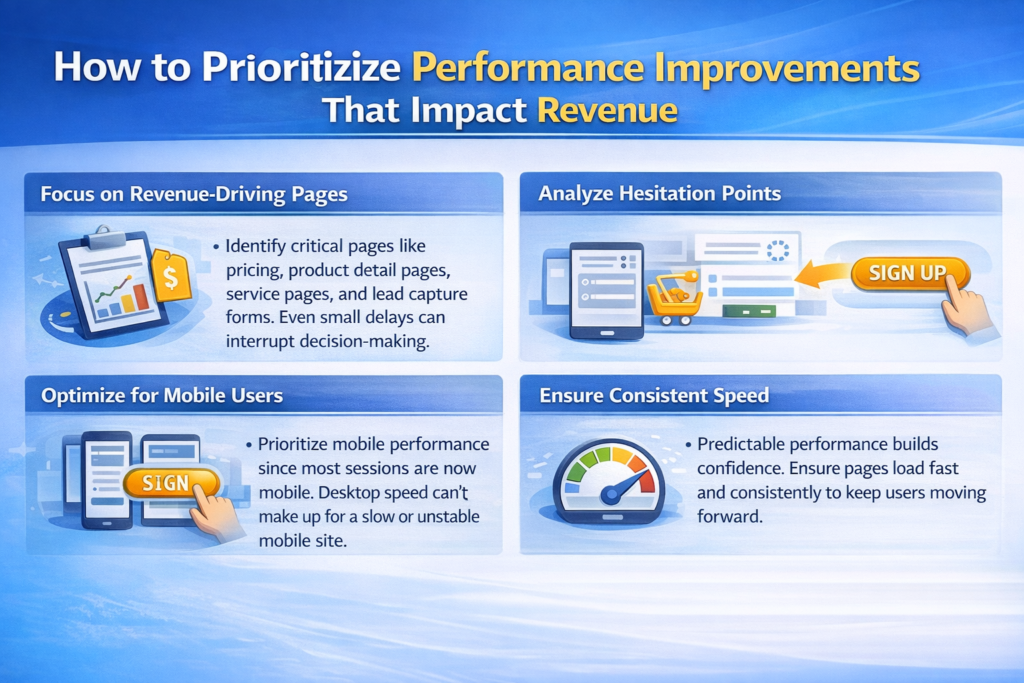
Not every page deserves the same level of attention. Leaders should start by identifying where money is actually made or lost.
Focus first on pages that sit closest to revenue such as pricing pages product detail pages service pages and lead capture forms. These pages carry intent. Even small delays here can interrupt decision making.
Next look at where users hesitate or drop off. Long waits before forms become usable delayed calls to action or sluggish interaction often explain conversion loss more clearly than messaging issues.
Mobile experience should be prioritized early. For many US businesses more than half of sessions now come from mobile devices. A fast desktop site does not compensate for a slow or unstable mobile experience.
Finally prioritize consistency. A page that is fast sometimes and slow other times creates uncertainty. Predictable performance builds confidence and keeps users moving forward.
Optimization areas leaders should focus on first
Some optimization efforts deliver far more impact than others. Leaders should guide teams toward areas that affect perception at critical moments.
• Initial page load on high intent pages
• Time before users can click scroll or type
• Visual stability during load and interaction
• Third party scripts that block or delay experience
• Images and media that slow down key pages
• Hosting and delivery setup that supports current traffic levels
These areas influence whether users feel in control or frustrated. That emotional response directly affects conversion behavior.
Connecting performance fixes to measurable business results
Performance improvements should always be tracked alongside business metrics. When done correctly the impact becomes obvious.
Faster load times reduce bounce rates and increase session depth. Smoother interactions lead to more completed forms and checkouts. Stable layouts reduce hesitation at the moment of action. Improved performance increases the efficiency of paid traffic by converting more of what you already pay for. Over time better performance also strengthens organic visibility and repeat engagement.
What this really means is that website performance optimization tips are not technical tricks. They are decision making tools. They help remove friction from the exact moments where users choose whether to trust your brand or walk away.
When leaders anchor performance work to outcomes instead of scores optimization stops feeling like maintenance and starts behaving like a growth strategy.
How Amatrons Technologies Thinks About Performance Optimization
At Amatrons Technologies performance optimization is not treated as a cleanup task or a one time technical sprint. It is approached as a business discipline tied directly to outcomes growth and long term digital resilience. The difference lies in how performance is framed before any optimization begins.
Outcome driven performance strategy
Performance work starts with understanding what the business is trying to achieve. Not what tool scores look like. Not what industry benchmarks say in isolation. The focus is on where performance is blocking progress.
Instead of optimizing everything at once the emphasis is on moments that matter. Pages where decisions are made. Actions where hesitation occurs. Journeys where users drop off despite strong intent.
Performance audits are translated into business language. Load delays are mapped to lost engagement. Interaction lag is connected to abandoned forms. Visual instability is tied to reduced trust. This clarity allows teams to prioritize fixes that actually move revenue and conversion metrics.
The strategy avoids surface level optimization. It looks at patterns. Consistency across sessions. Stability during traffic spikes. Predictability across devices. These factors determine whether performance improvements last or fade after the next release.
Aligning performance with growth and conversion goals
Performance is never isolated from growth initiatives. It is aligned with them. Marketing campaigns product launches and SEO efforts are evaluated through a performance lens before scale is applied.
If traffic is increasing performance must support it. If conversion goals rise experience friction must be reduced. If expansion into new regions is planned delivery infrastructure must be ready.
This alignment ensures that performance improvements support momentum rather than react to problems. It also creates shared ownership. Leadership marketing and engineering operate from the same performance objectives instead of disconnected metrics.
What this approach ultimately delivers is clarity. Performance is no longer an abstract technical concept. It becomes a measurable contributor to growth efficiency conversion confidence and long term digital credibility.
That is how performance optimization stops being reactive maintenance and starts functioning as a strategic advantage.
What Leaders Should Track and Ask
Website performance becomes a growth advantage only when leadership tracks the right signals and asks better questions. Vanity metrics and isolated technical scores rarely tell the full story. What matters is how performance influences behavior revenue and scalability.
Performance metrics that matter at leadership level
Leaders do not need dozens of dashboards. They need a small set of indicators that connect experience to outcomes.
• How quickly users can interact with key pages
• Bounce rate trends on high intent landing pages
• Conversion rate changes after performance improvements
• Mobile engagement versus desktop engagement
• Page stability issues that affect forms and checkout flows
• Performance consistency during campaigns or traffic spikes
• Cost per lead or acquisition before and after optimization
These metrics show whether performance supports growth or quietly restricts it. When tracked alongside revenue and marketing data the impact becomes clear and actionable.
Questions every CEO CMO and CTO should ask
The quality of questions determines the quality of decisions. Leaders should regularly challenge teams and vendors with questions that link performance to business results.
• Where are users experiencing the most friction today
• Which performance issues are directly hurting conversions
• How does website speed affect our paid traffic efficiency
• What happens to performance when traffic doubles
• Which pages lose the most users before conversion
• How consistent is performance across devices and locations
• What performance risks exist for upcoming campaigns or launches
These questions shift the conversation from technical status updates to strategic clarity. They also create accountability across teams by tying performance directly to growth outcomes.
When leaders track the right metrics and ask the right questions website performance stops being reactive firefighting. It becomes a controlled and measurable part of the growth strategy.
Conclusion Performance Optimization Is a Growth Decision
Website performance is no longer something businesses can afford to treat as background maintenance. It influences how users perceive your brand how confidently they move through the experience and whether they choose to convert or leave. In competitive US markets even small performance gaps create measurable disadvantages.
What becomes clear across speed user experience Core Web Vitals and technical foundations is this. Performance is not a technical task. It is a business decision. Every delay introduces friction. Every unstable interaction weakens trust. Every overlooked performance issue reduces the return on marketing and growth investments.
Leaders who treat performance optimization as a strategic priority gain leverage. They convert more of the traffic they already have. They reduce waste in paid channels. They strengthen organic visibility. Most importantly they create digital experiences that feel reliable and intentional.
Website performance optimization tips only deliver value when they are tied to outcomes. When performance work is aligned with revenue conversion and long term scalability it stops being a cost center and starts functioning as a growth multiplier.
The businesses that win are not always the ones with the loudest campaigns or the most features. They are the ones whose websites feel fast stable and trustworthy at every moment that matters.
FAQs
Why does website performance matter for established businesses?
Established brands often assume trust and recognition will compensate for poor performance. In reality expectations are higher. Users expect fast stable experiences from known brands. When performance falls short it creates doubt and frustration which leads to lost conversions and reduced loyalty.
How much revenue can slow performance impact?
Even small delays can create meaningful losses. A few seconds of added load time can reduce conversions noticeably especially on high intent pages. Over time this compounds into significant revenue leakage particularly for businesses with steady traffic volumes.
Are website performance optimization tips relevant beyond ecommerce?
Yes. Performance affects any business that relies on digital trust and user action. Lead generation platforms SaaS companies service providers and content driven businesses all experience lower engagement and fewer conversions when performance is weak.
How often should performance be reviewed?
Performance should be reviewed continuously with deeper evaluations before major campaigns launches or platform changes. Regular monitoring helps catch issues early before they affect revenue or user trust.
Can performance improvements reduce ad spend?
Yes. Faster and more stable landing pages convert a higher percentage of paid traffic. This improves cost efficiency and often reduces cost per lead or acquisition without increasing ad budgets.
Who should own website performance internally?
Performance should be shared across leadership marketing and technical teams. While execution sits with engineering accountability should remain at the leadership level to ensure alignment with business goals.
How long before performance improvements show results?
Some improvements show impact almost immediately through lower bounce rates and higher engagement. Broader benefits such as SEO and conversion lift become clearer over weeks as user behavior and rankings adjust.
How performance optimization supports long term SEO?
Search engines reward pages that provide strong user experiences. Better performance leads to improved engagement signals stronger visibility and more stable rankings over time making SEO efforts more sustainable.