
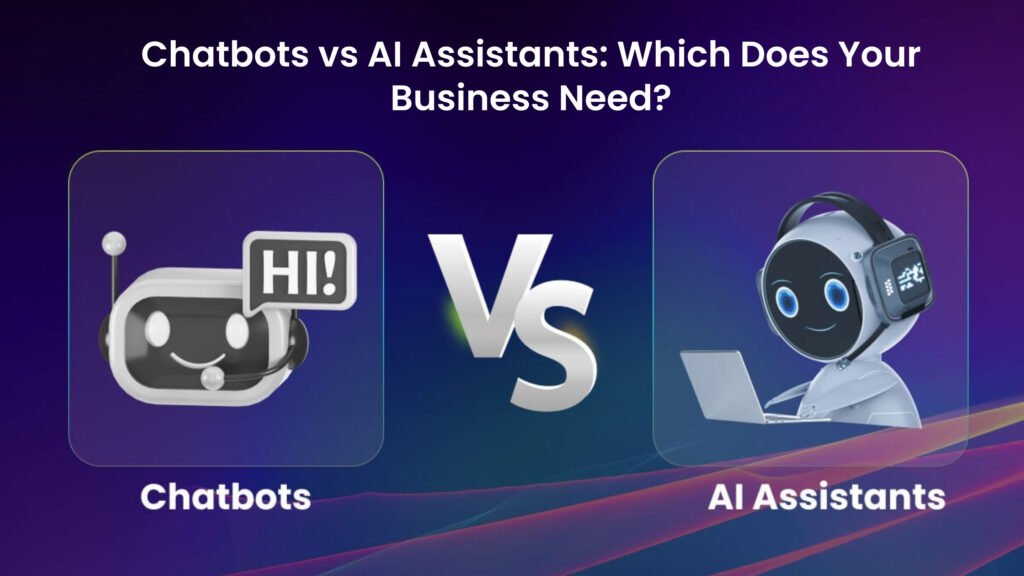
Chatbots vs AI Assistants: Which AI Customer Service Solution Is Right for Your Business?
Introduction to Chatbots vs AI Assistants in Customer Service Customer expectations have shifted dramatically. People now want instant answers, personalized interactions, and consistent support across every channel. For business leaders, this pressure translates into a simple but challenging question: how do you deliver faster, smarter, and more efficient customer service without inflating costs? AI customer service has stepped in as a powerful solution. Businesses today are exploring two main approaches: AI chatbots and AI assistants. While both seem similar at first glance, they solve very different problems. The choice between a chatbot and a virtual assistant can shape how your company handles growth, scales customer support, and builds brand loyalty. Think about it this way. A customer has a basic question about their order status. A chatbot can handle that in seconds. But when a customer needs personalized recommendations, troubleshooting, or even scheduling help, that is where AI assistants take over. Understanding the difference is no longer a technical detail. It is a leadership decision that impacts customer satisfaction, operational costs, and ultimately revenue. This article will break down the chatbot vs virtual assistant debate, highlight where each technology fits, share real-world use cases, and give you a roadmap for implementation. By the end, you will have a clear picture of which solution your business really needs and how to measure its long-term impact. Understanding the Basics of AI Customer Service What Are Chatbots and How Do They Work? An AI chatbot is designed to simulate a conversation with customers, usually through a website, mobile app, or messaging platform. Its primary job is to answer repetitive questions, guide users through standard processes, and keep support queues clear for more complex issues. Most chatbot tools today rely on Natural Language Processing to understand customer queries and respond in real time. They work well in handling structured requests such as: Checking order status Providing store hours or policies Directing customers to relevant knowledge base articles Capturing lead details for sales teams Industries such as eCommerce, banking, healthcare, and travel have widely adopted AI chatbots. For example, an online store may use a chatbot to handle shipping queries or refund requests, reducing the burden on human agents. Banks deploy chatbots to answer account balance questions instantly without requiring a call center executive. The strength of chatbots lies in efficiency. They are quick, consistent, and available around the clock. However, they often struggle when faced with open-ended or complex queries that require judgment, memory of past interactions, or multi-step problem solving. What Are AI Assistants and How Are They Different from Chatbots? AI assistants, sometimes called virtual assistants, go beyond scripted interactions. They are designed to handle context-rich conversations and support decision-making tasks. Instead of simply answering a question, an AI assistant can understand intent, process multiple layers of information, and act on behalf of the user. An AI assistant does not just respond—it integrates with business systems like CRM, ERP, or scheduling tools to perform tasks such as: Offering personalized product or service recommendations Booking meetings and sending reminders Managing customer onboarding workflows Providing multilingual support in real time Assisting employees with data insights and task automation Unlike basic chatbots, AI assistants learn over time. They analyze patterns in customer behavior, adapt responses, and can even predict what a customer might ask next. For example, an airline’s AI assistant could not only confirm a booking but also proactively offer check-in services, baggage policies, and personalized travel upgrades. The key difference is that AI assistants function more like digital team members than automated response systems. They are capable of becoming strategic assets in customer service and business operations. Chatbot vs Virtual Assistant: Key Differences At first glance, AI chatbots and AI assistants may seem interchangeable. Both engage customers through digital channels, both use artificial intelligence to respond, and both reduce the load on human teams. But the reality is that their scope, capabilities, and impact on business operations are very different. Scope of Interaction AI chatbots are reactive. They wait for a customer to ask a question and then respond within a predefined framework. Their role is to keep the conversation moving quickly and efficiently. AI assistants are proactive. They can anticipate needs, personalize suggestions, and even start interactions without being prompted. Think of a chatbot as a helpful clerk at the information desk, while an AI assistant feels closer to a digital advisor who understands your preferences and history. Complexity of Tasks Chatbots are built for speed and volume. They excel at answering high-frequency, low-complexity questions such as “Where is my order?” or “What are your opening hours?” AI assistants are designed for multi-step processes. They can manage workflows such as helping a customer troubleshoot a device, booking follow-up appointments, or offering financial planning guidance. Customer Experience The chatbot experience is efficient, but it can feel transactional. A customer gets an answer quickly but may sense the interaction is limited and somewhat robotic. AI assistants, on the other hand, are capable of delivering personalized, human-like experiences. They can remember previous interactions, adjust tone and recommendations, and create continuity across customer touchpoints. This higher level of engagement often leads to stronger brand loyalty. Technology Under the Hood Modern chatbot tools use Natural Language Processing to understand and match queries to pre-defined responses. Their intelligence depends on the training data and the scripts they are built on. AI assistants leverage more advanced machine learning and contextual AI models. They can analyze historical conversations, integrate with enterprise systems, and continuously improve through feedback loops. This makes them more adaptable and capable of scaling with the business. In short, chatbots are ideal for handling large volumes of simple interactions at scale, while AI assistants serve as digital collaborators capable of managing complex, personalized, and evolving needs. Why Businesses Struggle with AI Adoption Adopting AI in customer service sounds exciting on paper, but many companies quickly realize it is not as simple as flipping a switch. Leaders often face a gap between expectations and reality. This gap